
Die Application Gallery bietet COMSOL Multiphysics® Tutorial- und Demo-App-Dateien, die für die Bereiche Elektromagnetik, Strukturmechanik, Akustik, Strömung, Wärmetransport und Chemie relevant sind. Sie können diese Beispiele als Ausgangspunkt für Ihre eigene Simulationsarbeit verwenden, indem Sie das Tutorial-Modell oder die Demo-App-Datei und die dazugehörigen Anleitungen herunterladen.
Suchen Sie über die Schnellsuche nach Tutorials und Apps, die für Ihr Fachgebiet relevant sind. Beachten Sie, dass viele der hier vorgestellten Beispiele auch über die Application Libraries zugänglich sind, die in die COMSOL Multiphysics® Software integriert und über das Menü File verfügbar sind.

This example simulates the thermodynamical evolution of moist air in an electronic box with the aim of detecting whether condensation occurs when the external environment properties change. The model imports measured data for the air temperature, pressure, and water vapor concentration. ... Mehr lesen

Copper electrowinning is the process of copper extraction from an electrolyte solution and its deposition at the cathode surface, by passing an external current through the electrolytic cell and using an insoluble anode. During the process, oxygen bubbles are generated at the anode ... Mehr lesen
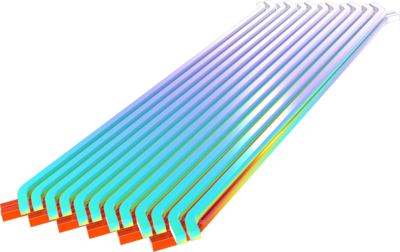
In a polymer electrolyte membrane fuel cell (PEMFC), water is produced at the cathode. The cell is also fed with water vapor via the inlet gas streams, in order to keep the polymer electrolyte membrane humidified. If the water partial pressure in the gas phase exceeds the vapor ... Mehr lesen
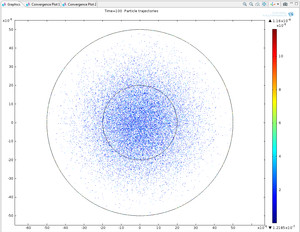
Transport which is purely diffusive in nature can be modeled using a Brownian force. This model shows how to add such a force in the Particle Tracing for Fluid Flow physics interface. Particle diffusion in a fluid is modeled with the diffusion equation and the Particle Tracing for Fluid ... Mehr lesen

This example is a model of a continuous casting process. Liquid metal is poured into a mold of uniform cross section. The outside of the mold is cooled and the metal solidifies as it flows through. When the metal leaves the mold, it is completely solidified on the outside, but still ... Mehr lesen

Aldicarb is a commercial pesticide, used on a variety of crops, including cotton, fruits, potatoes, and beans. This arises in the possibility that the general population may be exposed to aldicarb through the ingestion of contaminated water and foods. This example looks at the ... Mehr lesen
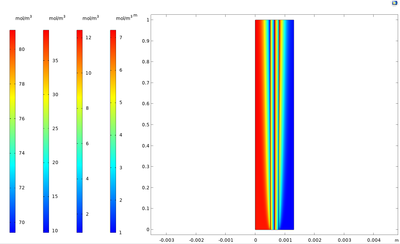
Example of membrane dialysis with a two-layered membrane. A second Reaction Engineering component models a tank connected to the inlet and outlets of the dialysate channel. Mehr lesen
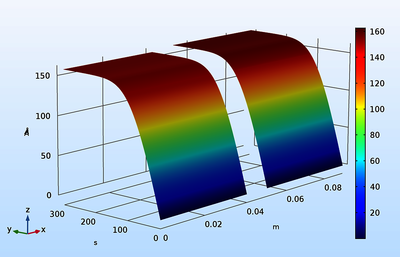
Surface chemistry is often an overlooked aspect of reacting flow modeling. This tutorial model shows how surface reactions and species can be added to study processes like chemical vapor deposition (CVD). The tutorial then models silicon growth on a wafer. Initially, the example uses a ... Mehr lesen
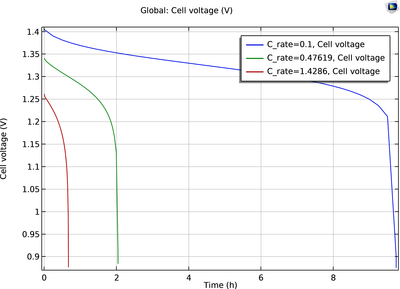
This model reproduces the NiCd battery model and the results presented in De Vidts' and White's paper from 1995. Ref: P. De Vidts, R. E. White, “Mathematical Modeling of a Nickel-Cadmium Cell: Proton Diffusion in the Nickel Electrode”, J. Electrochem. Soc, Vol. 142, No. 5, May 1995. Mehr lesen
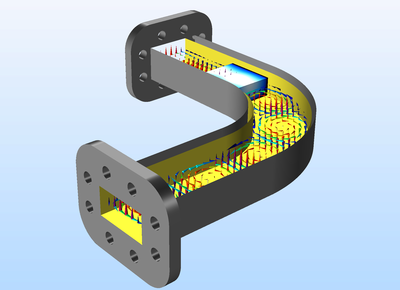
This is a model of an RF waveguide bend with a dielectric block inside. There are electromagnetic losses in the block as well as on the waveguide walls which cause the assembly to heat up over time. The material properties of the block are functions of temperature. The transient thermal ... Mehr lesen


