
Die Application Gallery bietet COMSOL Multiphysics® Tutorial- und Demo-App-Dateien, die für die Bereiche Elektromagnetik, Strukturmechanik, Akustik, Strömung, Wärmetransport und Chemie relevant sind. Sie können diese Beispiele als Ausgangspunkt für Ihre eigene Simulationsarbeit verwenden, indem Sie das Tutorial-Modell oder die Demo-App-Datei und die dazugehörigen Anleitungen herunterladen.
Suchen Sie über die Schnellsuche nach Tutorials und Apps, die für Ihr Fachgebiet relevant sind. Beachten Sie, dass viele der hier vorgestellten Beispiele auch über die Application Libraries zugänglich sind, die in die COMSOL Multiphysics® Software integriert und über das Menü File verfügbar sind.
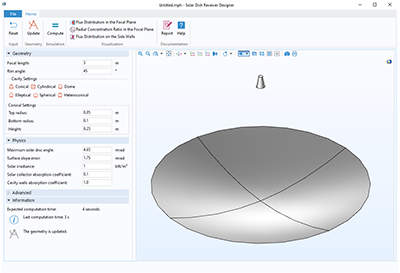
Solarkonzentrator-/ Cavity-Receiver-Systeme können dazu verwendet werden, die einfallende Sonnenstrahlung auf einen kleinen Bereich zu fokussieren und intensive Wärme zu erzeugen, die dann in elektrische oder chemische Energie umgewandelt werden kann. Eine gängige Kennzahl für ... Mehr lesen
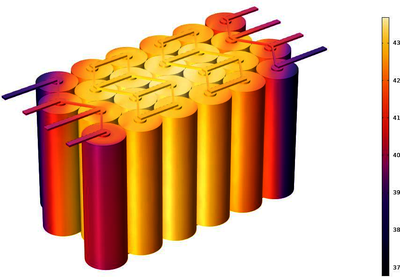
Diese App demonstriert: Dynamisches Hilfesystem mit Card Stacks Mehrere Komponenten (1D und 3D) in einer einzigen App Schaltflächen in der Multifunktionsleiste zum Anzeigen verschiedener Eingaben, Ausblenden/Einblenden von Geometrieauswahlen und für dynamische Hilfe Geometrieteile und ... Mehr lesen
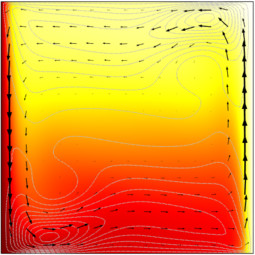
This model couples the Navier Stokes equations and the heat transfer equations to examine density driven flow of free fluids. Here the fluid is in a square cavity with a heated wall. The buoyancy force is a Boussinesq term added to the Navier-Stokes equations. The equation is ... Mehr lesen
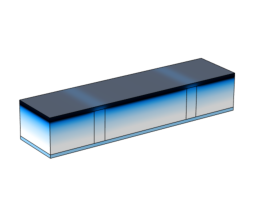
This 2D stationary model computes heat and moisture transport in a wall composed of different hygroscopic materials. A comparison with the Glaser method is given for the temperature and relative humidity solutions. The effect of the use of a vapor barrier is also investigated. Mehr lesen

This example shows how to compute deformations caused by secondary creep in a turbine stator blade. The creep rate is highly influenced by temperature, and the deformation and stress relaxation is thus controlled by the temperature field. Mehr lesen
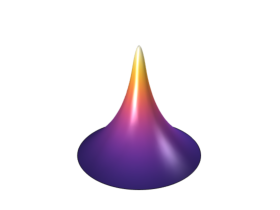
This classical verification model solves the steady state temperature distribution in a plan disk heated by a localized heat source at its center. It shows and compare different ways to define a heat source localized on a small domain by representing it either as a geometrical point or a ... Mehr lesen

In diesem Modell ist ein Knowles-ED23146-Receiver (Miniaturlautsprecher) mit einem Testaufbau verbunden, der aus einem 50 mm (1 mm Durchmesser) Ohrpassstück und einem so genannten 0.4-cc-Koppler besteht. Der Empfänger wird mit einem Lumped-Spice-Netzwerk modelliert und am Röhreneingang ... Mehr lesen
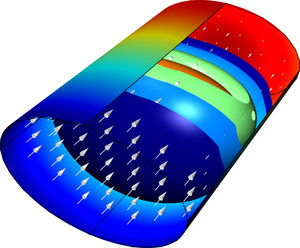
Several factors influence a diesel particulate filter’s (DPF) efficiency and durability. Important issues include the removal of soot particles from the filter membranes and the influence of thermal stress on the ceramic structure, stress that arises during repeated operating cycles. ... Mehr lesen
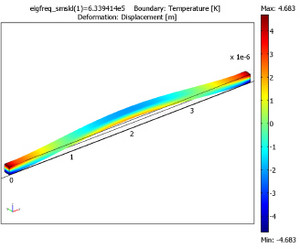
Thermoelastic damping, which arises when you subject a material to cyclic stress, is an important factor when designing MEMS resonators. The stress brings about deformation, where materials heat under compressive stress and cool under tensile stress. Thus, due to the resulting heat flux, ... Mehr lesen

Large FEM simulations can be costly and, if repeated simulations are needed, it can be beneficial to use reduced-order models (ROMs). ROMs are typically valid only in the vicinity of their design conditions and have lower accuracy, but the simulation time is significantly shorter. The ... Mehr lesen