
Die Application Gallery bietet COMSOL Multiphysics® Tutorial- und Demo-App-Dateien, die für die Bereiche Elektromagnetik, Strukturmechanik, Akustik, Strömung, Wärmetransport und Chemie relevant sind. Sie können diese Beispiele als Ausgangspunkt für Ihre eigene Simulationsarbeit verwenden, indem Sie das Tutorial-Modell oder die Demo-App-Datei und die dazugehörigen Anleitungen herunterladen.
Suchen Sie über die Schnellsuche nach Tutorials und Apps, die für Ihr Fachgebiet relevant sind. Beachten Sie, dass viele der hier vorgestellten Beispiele auch über die Application Libraries zugänglich sind, die in die COMSOL Multiphysics® Software integriert und über das Menü File verfügbar sind.
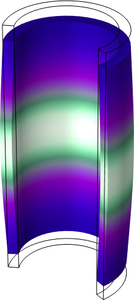
This model calculates the eigenfrequencies and mode shapes of an unconstrained cylinder in axisymmetry. The model is taken from NAFEMS Free Vibration Benchmarks. The eigenfrequencies are compared with the values given in the benchmark report. Three different physics interfaces are ... Mehr lesen

Dieses Modell zeigt eine vollständige vibroakustische Analyse eines Lautsprechers einschließlich Treiber, Gehäuse und Ständer. Sie können eine nominale Antriebsspannung anlegen und den resultierenden Schalldruckpegel im Gehäuse und im Außenraum sowie die Verformung des Gehäuses und des ... Mehr lesen
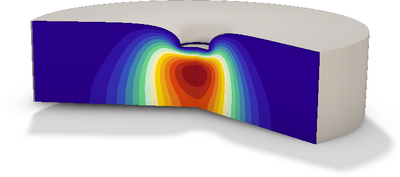
This example demonstrates how to use the Poroelasticity multiphysics coupling between the Solid Mechanics and Darcy's Law interfaces to model linear biphasic poroviscoelastic behavior of soft biological tissues. The implementation is verified using two numerical benchmarks from the ... Mehr lesen
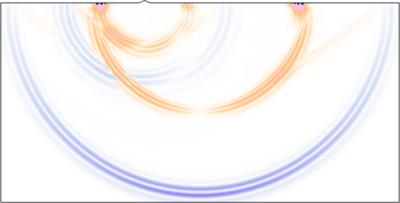
Die Ausbreitung elastischer Wellen im Boden nach einem seismischen Ereignis wird mithilfe eines 2D-Modells simuliert. Der Einfluss der Topologie der Bodenoberfläche auf die Wellenausbreitung wird veranschaulicht, indem ein idealer Halbraum durch das Vorhandensein eines kleinen Berges ... Mehr lesen
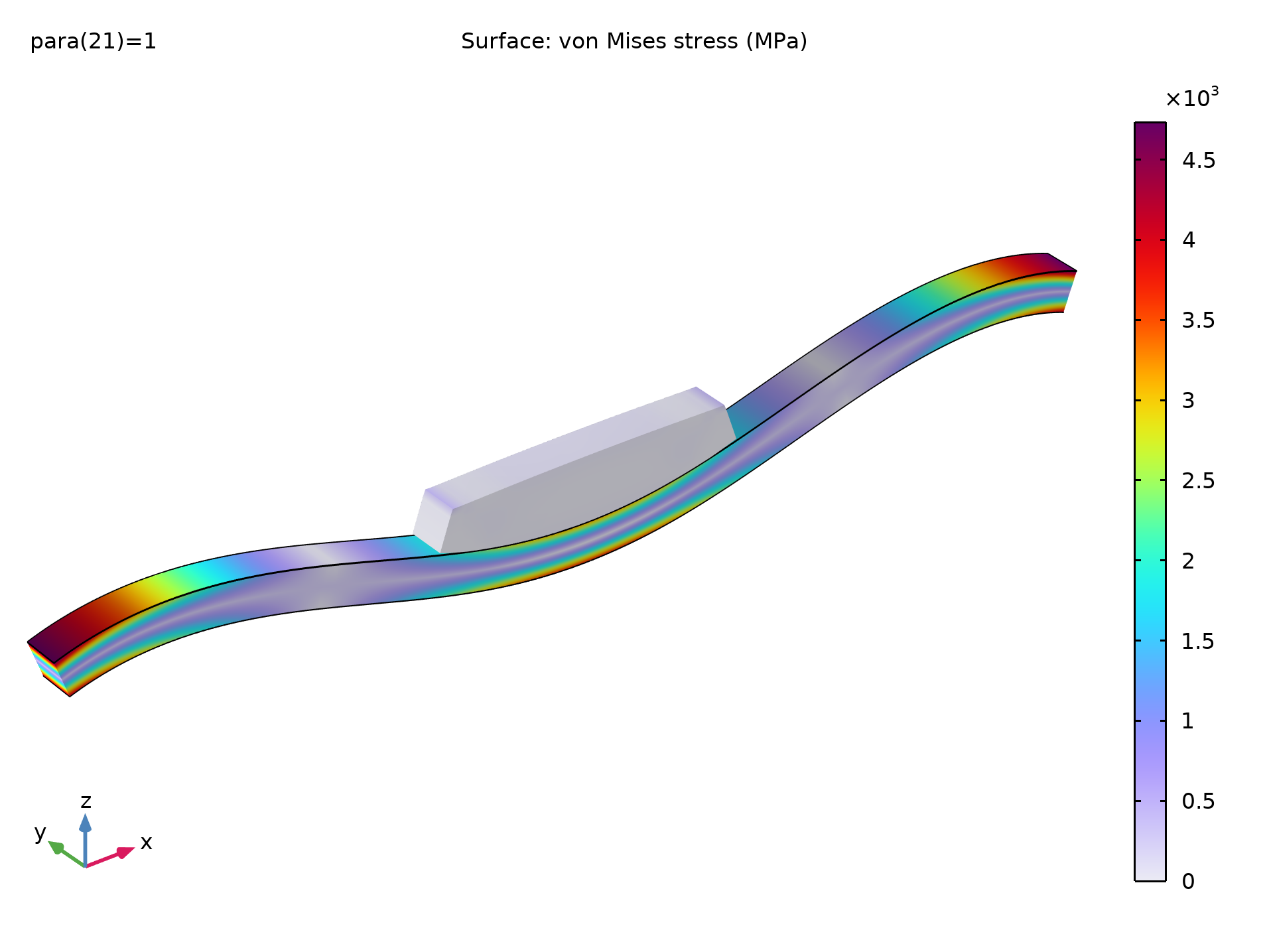
This conceptual example shows how to calculate critical points in models with contact. The model consists of a block modeled with the Solid Mechanics interface pressing on an arch modeled with the Shell interface. The contact problem is solved using the augmented Lagrangian method. The ... Mehr lesen
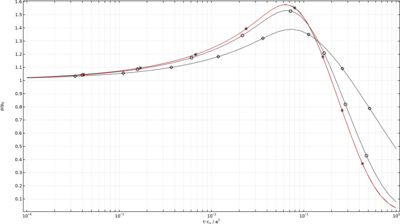
Cryer's problem is a three-dimensional consolidation benchmark. A porous sphere is subjected to a uniform boundary pressure. The pore pressure at the center of the sphere rises due to the Mandel-Cryer effect that is captured by a two-way coupling between Darcy's law and solid mechanics. Mehr lesen

This is a small 2D demonstration model that couples the Linearized Navier-Stokes, Frequency Domain, Solid Mechanics, and Turbulent Flow (k-epsilon) physics interfaces to model the vibrations of a plate located in a 2D viscous parallel plate flow. This type of model is used to model fluid ... Mehr lesen

A demonstration of topology optimization using the Structural Mechanics Module and the Optimization Module. The classical MBB beam is solved in 2D using a Helmholtz filter and Solid Isotropic Material Penalization (SIMP) technique to recast the original combinatorial optimization problem ... Mehr lesen

In this example, the External Stress feature in the Solid Mechanics interface is used to provide the material model with the nonsymmetric stress required in the design of an elastic invisibility cloak. The cloak is a domain with special material properties aimed at shielding a region of ... Mehr lesen
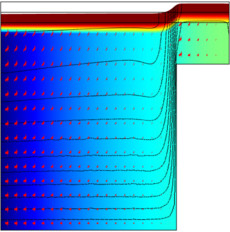
The Poroelasticity interface couples Darcy's law and solid mechanics to assess deformation of porous media that results from fluid withdrawals. The model builds on top of the Terzaghi Compaction example. Results from Terzaghi compaction and Biot poroelasticity analyses are compared to ... Mehr lesen


