
Die Application Gallery bietet COMSOL Multiphysics® Tutorial- und Demo-App-Dateien, die für die Bereiche Elektromagnetik, Strukturmechanik, Akustik, Strömung, Wärmetransport und Chemie relevant sind. Sie können diese Beispiele als Ausgangspunkt für Ihre eigene Simulationsarbeit verwenden, indem Sie das Tutorial-Modell oder die Demo-App-Datei und die dazugehörigen Anleitungen herunterladen.
Suchen Sie über die Schnellsuche nach Tutorials und Apps, die für Ihr Fachgebiet relevant sind. Beachten Sie, dass viele der hier vorgestellten Beispiele auch über die Application Libraries zugänglich sind, die in die COMSOL Multiphysics® Software integriert und über das Menü File verfügbar sind.
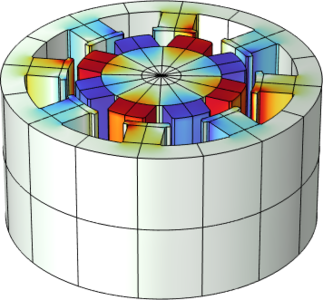
Diese App veranschaulicht, wie man eine elektrische Maschine wie einen Generator, Motor oder Antrieb modelliert, indem man die Sektorsymmetrie ausnutzt, um die Größe des Problems zu reduzieren. Die untersuchte Maschine ist ein vereinfachter elektrischer Generator in 3D, der auf der in ... Mehr lesen
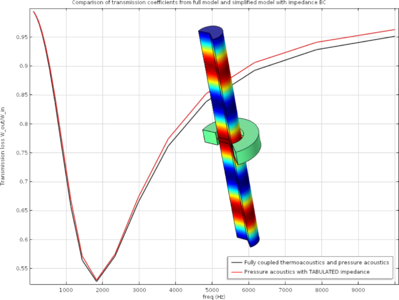
This application illustrates a modeling approach for deriving physically consistent simplified models in the Acoustics Module. The approach consists of converting complex sub-components to an impedance boundary condition and otherwise using simple acoustics throughout the COMSOL model. ... Mehr lesen
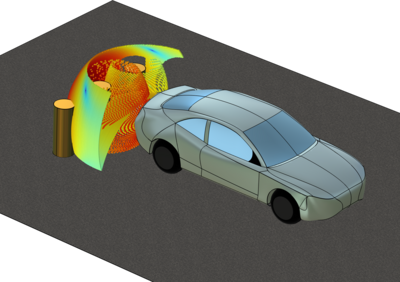
Dieses Tutorial zeigt Ihnen, wie Sie die Antwort eines Ultraschallsensors für das Einparken von Autos berechnen können, indem Sie die Interfaces Pressure Acoustics, Frequency Domain, Solid Mechanics und Piezoelectric Materials miteinander koppeln. Das Fernfeld-Strahlungsmuster des ... Mehr lesen

This tutorial demonstrate the use of a Cross Grating feature in an échelle spectrograph. A cross grating is a periodic surface with two directions of periodicity. In this model the cross grating is used in high order in one direction and in first order in the orthogonal ("cross") ... Mehr lesen
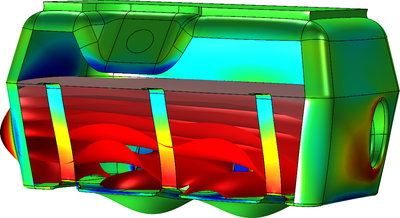
This model analyzes the frequency response of a fuel tank partially filled with fluid. The tank is submitted to a vertical acceleration. Two modeling methods are considered to represent the fluid: a traditional method of smearing the mass of the fluid through the wetted surface of the ... Mehr lesen
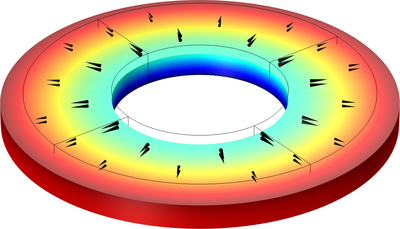
This tutorial model shows how a user-defined coordinate system can be used to create any type of directional polarization of a piezoelectric material. Results are shown for the case of radial polarization of a piezoelectric disk. The piezoelectric material is PZT-5H. The example shows a ... Mehr lesen
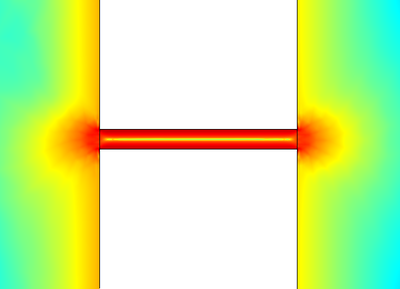
This small tutorial model studies energy conservation in a small conceptual test setup. The model has an inlet and outlet (modeled using ports) and a Helmholtz resonator with a very narrow neck. The acoustics in the narrow neck are modeled with Thermoviscous Acoustic for a detailed ... Mehr lesen

This model utilizes the thermoviscous acoustic interface in a sub-model to obtain detailed results for the transfer impedance of a perforated plate (including the thermal and viscous losses). The impedance is in turn used as an internal impedance in a pressure acoustic model of a ... Mehr lesen

The GEC cell was introduced by NIST in order to provide a standardized platform for experimental and modeling studies of discharges in different laboratories. The plasma is sustained via inductive heating. The Reference Cell operates as an inductively-coupled plasma in this model. This ... Mehr lesen

This example shows how to make a simple model for a binary distillation process. A thermodynamics property package, available in the Chemical Reaction Engineering Module, is created to study the separation of a nonideal mixture of ethanol and water. The required equilibrium relationship ... Mehr lesen