
Die Application Gallery bietet COMSOL Multiphysics® Tutorial- und Demo-App-Dateien, die für die Bereiche Elektromagnetik, Strukturmechanik, Akustik, Strömung, Wärmetransport und Chemie relevant sind. Sie können diese Beispiele als Ausgangspunkt für Ihre eigene Simulationsarbeit verwenden, indem Sie das Tutorial-Modell oder die Demo-App-Datei und die dazugehörigen Anleitungen herunterladen.
Suchen Sie über die Schnellsuche nach Tutorials und Apps, die für Ihr Fachgebiet relevant sind. Beachten Sie, dass viele der hier vorgestellten Beispiele auch über die Application Libraries zugänglich sind, die in die COMSOL Multiphysics® Software integriert und über das Menü File verfügbar sind.
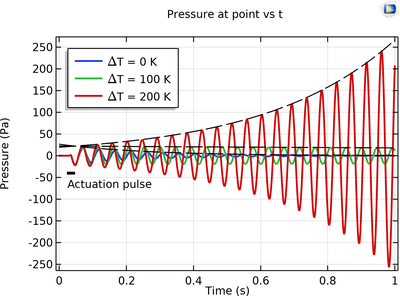
Dies ist ein Modell eines einfachen thermoakustischen Motors, der einen thermischen Stack zur Umwandlung von Wärmeenergie in akustische Energie enthält. Das Modell wird mit zwei Ansätzen aufgebaut: 1) Mit einem linearen Störungsansatz (akustisch) wird die Fluidbewegung mit dem Interface ... Mehr lesen

Large FEM simulations can be costly and, if repeated simulations are needed, it can be beneficial to use reduced-order models (ROMs). ROMs are typically valid only in the vicinity of their design conditions and have lower accuracy, but the simulation time is significantly shorter. The ... Mehr lesen
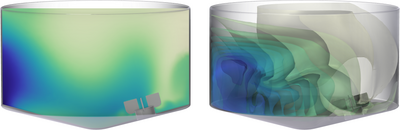
This space-dependent model describes a stirred semibatch reactor used for producing antibody–drug conjugates. The reactor is set up in 3D and the conjugation reactions, turbulent flow, and concentration fields are simulated as functions of time. The resulting yield and drug-to-antibody ... Mehr lesen
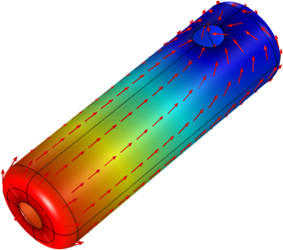
A goal for many applications is to predict physics in thin structures, such as shells, without modeling the thickness of the structure. This is because large aspect ratios can cause meshing and geometry analysis problems. This model demonstrates how to use the tangential derivative ... Mehr lesen
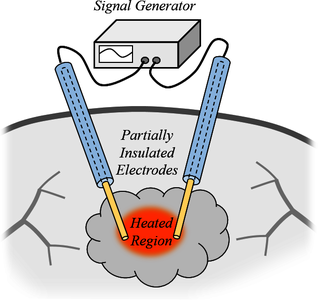
Dieses Beispiel zeigt, wie Sie die Gewebeablation durch Anwendung von Hochfrequenzstrahlung modellieren können. Eine detailliertere Beschreibung des Phänomens und des Modellierungsprozesses finden Sie in dem Blog-Beitrag "Study Radiofrequency Tissue Ablation Using Simulation". Mehr lesen

Silicon carbide (SiC) epitaxial furnaces are a specialized equipment for the production and preparation of SiC epitaxial wafers. This example model demonstrates the process of preparing an SiC epitaxial wafer based on the physical vapor transport (PVT) method in a furnace. This involves ... Mehr lesen
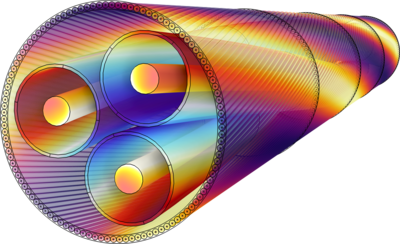
Mit dieser Serie von acht Tutorial-Modellen und der dazugehörigen Dokumentation können Sie die resistiven, kapazitiven, induktiven und thermischen Eigenschaften eines standardmäßigen dreiadrigen bleiummantelten XLPE-HVAC-Unterseekabels mit verdrillter Magnetarmierung (500 mm2, 220 kV) ... Mehr lesen
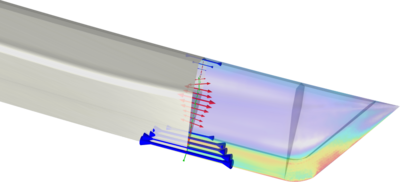
The katana is a legendary Japanese sword used by the samurai in olden days. Here, we present a simple model where we simulate a differential hardening process to explore some of the features of the katana. Learn more in this related blog post: Modeling the Differential Quenching of a ... Mehr lesen
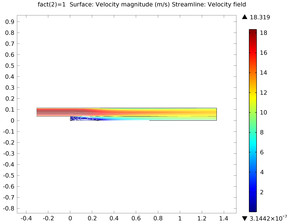
The backward facing step is an interesting case for studying the performance and solution strategy of a turbulence model. In this case, the flow is subjected to a sudden increase of cross-sectional area, resulting in a separation of flow starting at the point of expansion. Spatial ... Mehr lesen

This tutorial model shows how to import data from an ODB++® archive to generate a geometry of a printed circuit board (PCB). Follow the instructions to learn how to remove small details from the geometry, create a mesh, and use automatically generated selections to define physics and ... Mehr lesen