
Die Application Gallery bietet COMSOL Multiphysics® Tutorial- und Demo-App-Dateien, die für die Bereiche Elektromagnetik, Strukturmechanik, Akustik, Strömung, Wärmetransport und Chemie relevant sind. Sie können diese Beispiele als Ausgangspunkt für Ihre eigene Simulationsarbeit verwenden, indem Sie das Tutorial-Modell oder die Demo-App-Datei und die dazugehörigen Anleitungen herunterladen.
Suchen Sie über die Schnellsuche nach Tutorials und Apps, die für Ihr Fachgebiet relevant sind. Beachten Sie, dass viele der hier vorgestellten Beispiele auch über die Application Libraries zugänglich sind, die in die COMSOL Multiphysics® Software integriert und über das Menü File verfügbar sind.

Many applications involve simulating the electromagnetic behavior of relatively thin material in voluminous domains. To save computer memory and processing time, the thin materials can be treated differently by resolving them with 3D meshes. Here, the modeling domain is a box filled ... Mehr lesen
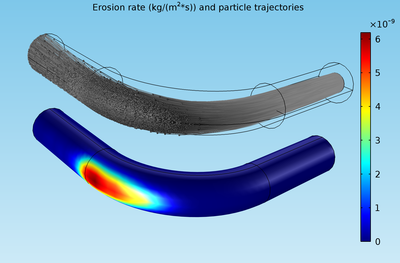
The Particle Tracing for Fluid Flow interface is used to compute the erosion of a pipe bend. The amount of material lost is computed using different erosion models. Mehr lesen

Die Trocknung poröser Medien ist ein wichtiger Prozess unter anderem in der Lebensmittel- und Papierindustrie. Viele physikalische Effekte müssen berücksichtigt werden: Strömung, Wärmetransport mit Phasenwechsel und Transport der beteiligten Flüssigkeiten und Gase. Alle diese Effekte ... Mehr lesen
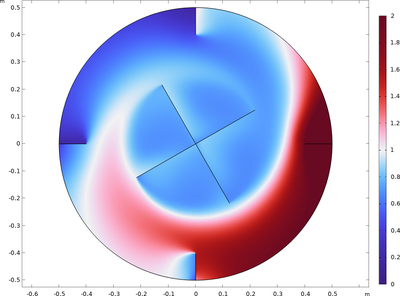
This example shows how the mixing capability of a stirred vessel can be evaluated. To efficiently reach the steady operational conditions the turbulent flow is solved for using a frozen rotor analysis, and a following time dependent simulation. When a quasi-steady flow field has ... Mehr lesen

This tutorial model solves the Gross–Pitaevskii Equation for the vortex lattice formation in a rotating Bose–Einstein condensate bound by a harmonic trap. The equation is essentially a nonlinear single-particle Schrödinger Equation, with the inter-particle interaction represented by a ... Mehr lesen
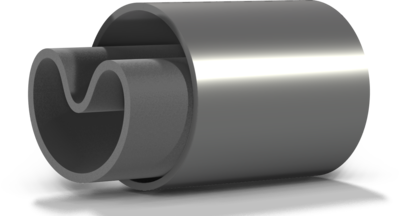
In this example, the Bergstrom–Bischoff material model is used to model the temperature and strain dependent behavior of High Density Polyethylene (HDPE) used, for example, to make liners for damaged pipes in oil and gas applications, or to make type IV hydrogen storage vessels for fuel ... Mehr lesen

Das vorliegende Modellbeispiel basiert auf dem Modell „Kupferabscheidung in einem Trench“, das in der Electrodeposition Application Library verfügbar ist. Die ungleichmäßige Abscheidung entlang der Trenchoberfläche führt zur Bildung eines Hohlraums. Da das Interface Deformed Geometry ... Mehr lesen
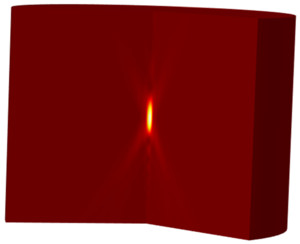
Dieses Tutorial zeigt, wie die durch fokussierten Ultraschall induzierte Gewebeerwärmung modelliert werden kann. Zunächst wird das stationäre Schallfeld im Wasser und im Gewebe modelliert, um die Schallintensitätsverteilung im Gewebe zu erhalten. Die absorbierte Schallenergie wird dann ... Mehr lesen

This tutorial model solves for an inductively coupled plasma reactor in a mixture of argon/oxygen. The model computes the fluid flow and gas heating. Important aspects and strategies for modeling electronegative discharges are discussed. Mehr lesen

Microlaboratories for biochemical applications often require rapid mixing of different fluid streams. At the microscale, flow is usually highly ordered laminar flow, and the lack of turbulence makes diffusion the primary mechanism for mixing. While diffusional mixing of small ... Mehr lesen