
Die Application Gallery bietet COMSOL Multiphysics® Tutorial- und Demo-App-Dateien, die für die Bereiche Elektromagnetik, Strukturmechanik, Akustik, Strömung, Wärmetransport und Chemie relevant sind. Sie können diese Beispiele als Ausgangspunkt für Ihre eigene Simulationsarbeit verwenden, indem Sie das Tutorial-Modell oder die Demo-App-Datei und die dazugehörigen Anleitungen herunterladen.
Suchen Sie über die Schnellsuche nach Tutorials und Apps, die für Ihr Fachgebiet relevant sind. Beachten Sie, dass viele der hier vorgestellten Beispiele auch über die Application Libraries zugänglich sind, die in die COMSOL Multiphysics® Software integriert und über das Menü File verfügbar sind.

A vessel traveling on the surface or under water gives rise to detectable local disturbances in the Earth’s magnetic field. These disturbances can be used to trigger weapon systems. The magnetic signature of a ship can be reduced by generating a counteracting magnetic field of suitable ... Mehr lesen
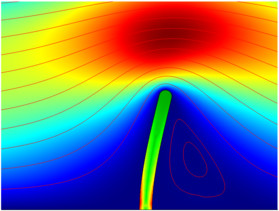
Dieses Modell zeigt, wie Sie ein Fluid-Struktur-Interaktionsproblem in COMSOL Multiphysics einrichten können. Es veranschaulicht, wie eine Strömung feste Strukturen verformen kann und wie man die Strömung in einer sich kontinuierlich verformenden Geometrie löst. Das Multiphysik ... Mehr lesen

The strength reduction technique is a tool to find the factor of safety (FOS) in geotechnical problems, particularly in slope stability analyses. To determine the factor of safety of the slope, the strength properties in the Mohr–Coulomb model are gradually reduced until failure occurs. ... Mehr lesen

Crystallization is an important separation process in the chemical industry. It is used for the production of pharmaceuticals and industrial chemicals. It can also be used in resource recovery as a way of separating valuable materials from waste. This model solves a discretized ... Mehr lesen

Die Hauptverteidigung eines U-Boots besteht in seiner Fähigkeit, während der Fahrt verborgen zu bleiben. Da Radiowellen vom Meerwasser stark absorbiert werden, ist Sonar eine der wichtigsten Methoden zum Aufspüren von U-Booten. Sonarsysteme werden auch bei der Unterwasserforschung und in ... Mehr lesen

Droplet evaporation is ubiquitous in everyday life and is essential in many industrial processes, such as inkjet printing, cleaning/coating of surfaces, and phase change heat transfer. This model demonstrates how to model phase transition by a moving exterior boundary condition using ... Mehr lesen

A diplexer is a device that combines or splits signals into two different frequency bands, widely used in mobile communication systems. This model simulates splitting properties using a simplified 2D geometry. The computed S-parameters and electric fields at the lower and upper bands ... Mehr lesen

The catenary is the geometrical shape that corresponds to the curve followed by an idealized chain or cable supported at both ends and hanging under its own weight. The viscous catenary problem describes the motion of a cylinder of highly viscous fluid, supported at its ends as it flows ... Mehr lesen

At the macroscopic level, systems usually mix fluids using mechanical actuators or turbulent 3D flow. At the microscale level, however, neither of these approaches is practical or even possible. This model demonstrates the mixing of fluids using laminar-layered flow in a MEMS mixer. This ... Mehr lesen
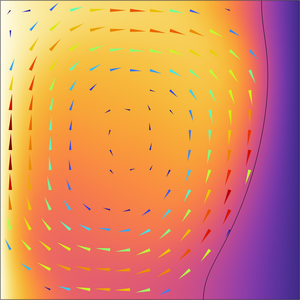
This example demonstrates how to model phase transition by a moving boundary interface according to the Stefan problem. A square cavity containing both solid and liquid tin is submitted to a temperature difference between left and right boundaries. Fluid and solid parts are solved in ... Mehr lesen


