
Die Application Gallery bietet COMSOL Multiphysics® Tutorial- und Demo-App-Dateien, die für die Bereiche Elektromagnetik, Strukturmechanik, Akustik, Strömung, Wärmetransport und Chemie relevant sind. Sie können diese Beispiele als Ausgangspunkt für Ihre eigene Simulationsarbeit verwenden, indem Sie das Tutorial-Modell oder die Demo-App-Datei und die dazugehörigen Anleitungen herunterladen.
Suchen Sie über die Schnellsuche nach Tutorials und Apps, die für Ihr Fachgebiet relevant sind. Beachten Sie, dass viele der hier vorgestellten Beispiele auch über die Application Libraries zugänglich sind, die in die COMSOL Multiphysics® Software integriert und über das Menü File verfügbar sind.
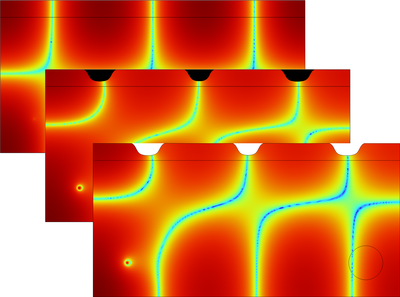
This tutorial introduces the use of topology optimization in acoustics. The goal of the optimization is to find the optimal material distribution (solid or air) in a given design domain, here the ceiling of a 2D room, that minimizes the average sound pressure level in an objective ... Mehr lesen
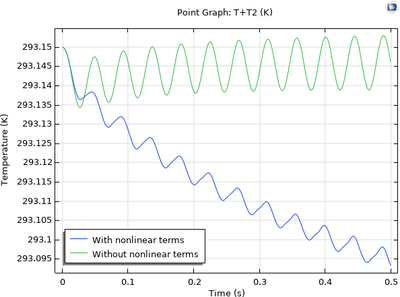
Ein thermoakustischer Motor ist ein Gerät ohne bewegliche Teile, das akustische Energie aus Temperaturgradienten innerhalb des Motors erzeugen kann. Er nutzt die Beziehung zwischen der Bewegung oszillierender Luft und den Temperaturänderungen in der durch die akustischen Wellen ... Mehr lesen
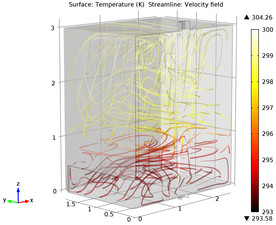
In general, there are two classes of ventilation: mixing ventilation and displacement ventilation. In displacement ventilation, air enters a room at the floor level and displaces warmer air to achieve the desired temperature. Heating sources in the room can include running electronic ... Mehr lesen
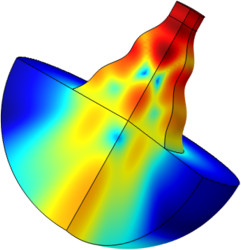
A plane-wave mode feeds an axisymmetric horn radiating from an infinite baffle toward an open half space. The radius of the waveguide attached to the horn throat is assumed to be fixed, as well as the depth of the horn and the size of the horn mouth attached to the baffle. By varying the ... Mehr lesen
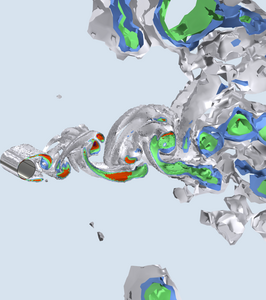
The model compare the two RANS models SST and SST-SAS for turbulent flow around a cylinder. The SST-SAS model resolve more transversal turbulent structures comared to the SST model. Mehr lesen

An operational amplifier (op-amp) is a differential voltage amplifier with a wide range of applications in analog electronics. This tutorial models an op-amp connected to a feedback loop and a capacitive load. The op-amp is modeled as an equivalent linear subcircuit in the Electrical ... Mehr lesen
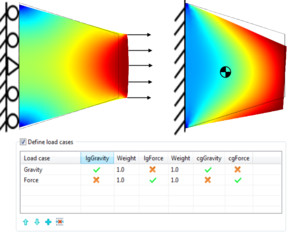
This example shows a 2D plane stress model of a thin tapered cantilever. Different boundary and load scenarios are examined. It is demonstrated how to apply and how to evaluate different load and constraint groups. Resulting stresses are compared to NAFEMS benchmark values and they are ... Mehr lesen

Dieses Beispiel beschreibt eine Reihe von Heizungsrohren, die in einen Behälter eingetaucht sind, wobei eine Strömung am Boden eintritt. Es handelt sich um ein multiphysikalisches Modell, da es die Strömungsdynamik mit dem Wärmetransport gekoppelt behandelt. Der Druck und das ... Mehr lesen
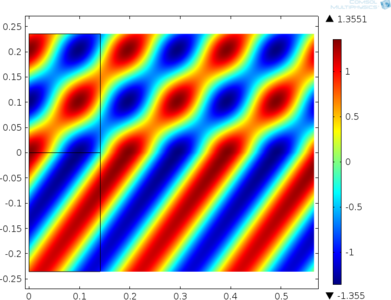
This model determines the reflection coefficient of plane acoustic waves, at different frequencies and at different angles of incidence, off a water-sediment interface. The ability of the Poroelasitc Waves interface to model the coupled acoustic and elastic wave in any porous substance ... Mehr lesen
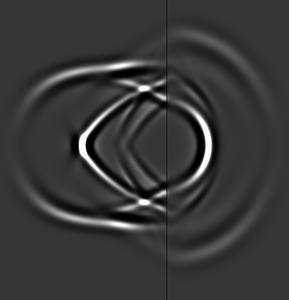
In this 2D tutorial, a test sample consists on one side of an isotropic material and on the other side of a heterogeneous anisotropic material (a transverse anisotropic zinc crystal). Elastic waves in the sample are excited by a point-like force. The model is solved with the Elastic ... Mehr lesen


