
Die Application Gallery bietet COMSOL Multiphysics® Tutorial- und Demo-App-Dateien, die für die Bereiche Elektromagnetik, Strukturmechanik, Akustik, Strömung, Wärmetransport und Chemie relevant sind. Sie können diese Beispiele als Ausgangspunkt für Ihre eigene Simulationsarbeit verwenden, indem Sie das Tutorial-Modell oder die Demo-App-Datei und die dazugehörigen Anleitungen herunterladen.
Suchen Sie über die Schnellsuche nach Tutorials und Apps, die für Ihr Fachgebiet relevant sind. Beachten Sie, dass viele der hier vorgestellten Beispiele auch über die Application Libraries zugänglich sind, die in die COMSOL Multiphysics® Software integriert und über das Menü File verfügbar sind.
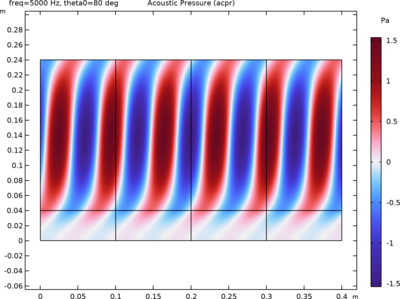
This is a 2D model of an anisotropic porous absorbing material. The absorption coefficient alpha are determined as functions of frequency for three different incidence angles. The example uses Periodic Floquet boundary conditions. The model uses two different methods for modeling the ... Mehr lesen

In this example, the homogenized elastic and viscoelastic properties of a particulate composite are computed based on the individual properties of elastic particles embedded in a viscoelastic matrix. Periodic boundary conditions are applied to a unit cell of the particulate composite ... Mehr lesen

This conceptual example shows how to handle a transient contact problem with stick-slip friction transition. A soft hollow pipe subjected to gravity is released at the top of a halfpipe. The pipe motion varies between sliding and rolling, depending on its position in the halfpipe and its ... Mehr lesen
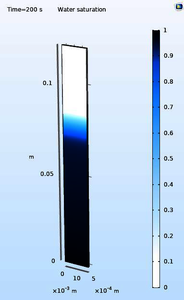
This example models wicking in a porous medium. Wicking is the phenomenon that occurs when a dry porous material is put into contact with a fluid: it will absorb the fluid due to capillary forces. The absorption will continue until an equilibrium is reached where the gravitational forces ... Mehr lesen
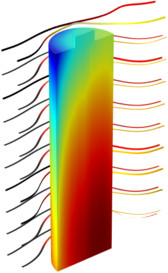
Dieses Beispiel simuliert das Wärmeprofil in einem luftgekühlten zylindrischen Akku in 3D. Der Akku befindet sich in einer Matrix in einem Akkupack. Das thermische Modell ist mit einem 1D- Akkumodell gekoppelt, das verwendet wird, um eine Wärmequelle im aktiven Akkumaterial zu erzeugen. Mehr lesen
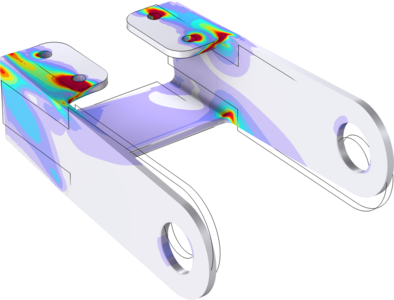
Die Halterungsmodelle dienen als Einführung in die strukturmechanische Modellierung mit dem Structural Mechanics Module. Folgende Features werden vorgestellt: Die Grundlagen: Statische lineare Analyse Parametrische Studie Einbeziehung der Anfangsdehnung Modellierung der thermischen ... Mehr lesen

At the macroscopic level, systems usually mix fluids using mechanical actuators or turbulent 3D flow. At the microscale level, however, neither of these approaches is practical or even possible. This model demonstrates the mixing of fluids using laminar-layered flow in a MEMS mixer. This ... Mehr lesen
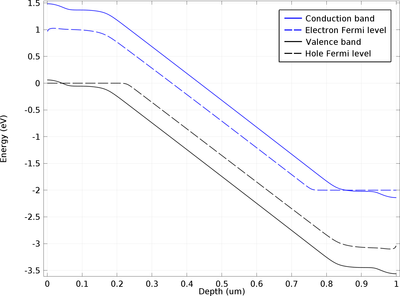
Dieses einfache Modell zeigt, wie Sie die Interfaces Semiconductor Optoelectronics verwenden können, um eine einfache GaAs-PIN-Diodenstruktur zu modellieren. Sowohl die stimulierte als auch die spontane Emission im Halbleiter werden berücksichtigt. Die entsprechende Absorption des Lichts ... Mehr lesen
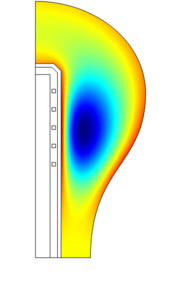
This model simulates an electrodeless lamp with argon/mercury chemistry. The low excitation threshold for mercury atoms means that even though the mercury is present in small concentrations, its behavior dominates. There is strong UV emission from the plasma at 185 nm and 253 nm. The UV ... Mehr lesen
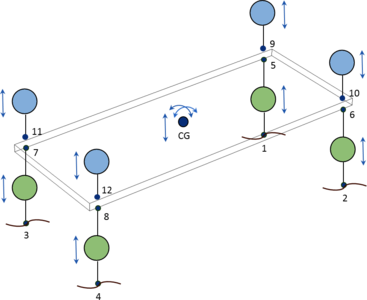
In this example, a lumped model of a vehicle suspension system having 11 degrees of freedom is analyzed. The Mass, Spring, and Damper nodes of the Lumped Mechanical System interface are used to model the wheels, including suspension system as well as the seats with a passenger. The ... Mehr lesen