
Die Application Gallery bietet COMSOL Multiphysics® Tutorial- und Demo-App-Dateien, die für die Bereiche Elektromagnetik, Strukturmechanik, Akustik, Strömung, Wärmetransport und Chemie relevant sind. Sie können diese Beispiele als Ausgangspunkt für Ihre eigene Simulationsarbeit verwenden, indem Sie das Tutorial-Modell oder die Demo-App-Datei und die dazugehörigen Anleitungen herunterladen.
Suchen Sie über die Schnellsuche nach Tutorials und Apps, die für Ihr Fachgebiet relevant sind. Beachten Sie, dass viele der hier vorgestellten Beispiele auch über die Application Libraries zugänglich sind, die in die COMSOL Multiphysics® Software integriert und über das Menü File verfügbar sind.

This model, dealing with the current and potential distribution around one pair of electrodes, demonstrates how to synchronize and modify geometry in Inventor® by using the LiveLink™ interface with a parametric sweep. Mehr lesen
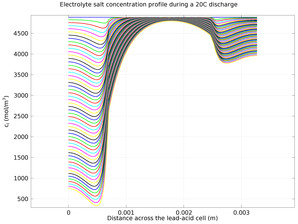
Lead-acid batteries are widely used as starting batteries for various traction applications such as cars and trucks and so forth. The reason for this is the fairly low cost in combination with the performance robustness for a broad range of operating conditions. However, one drawback of ... Mehr lesen
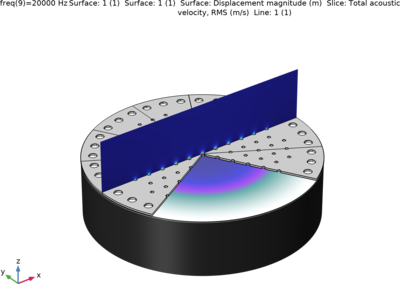
This is a model of a MEMS microphone solved in the frequency domain including the DC prestress effects. The model is set up using the Electromechanics multiphysics interface, Thermoviscous Acoustics, and Pressure Acoustics. The microphone consists of a perforated plate and a prestressed ... Mehr lesen
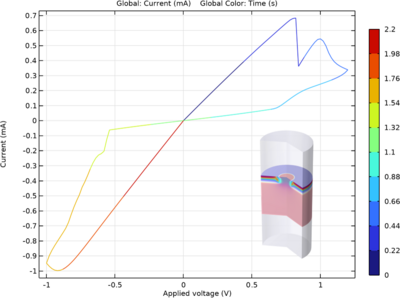
This model captures the dynamic resistive switching behavior of an oxide-based memristor. The device features a thin metal oxide layer sandwiched between two metal electrodes. When a voltage is applied, oxygen vacancies within the oxide layer migrate, acting as charge carriers and ... Mehr lesen
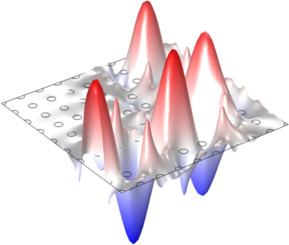
Photonische Kristalle sind periodische Strukturen aus abwechselnden Schichten von Materialien mit unterschiedlichen Brechungsindizes. Wellenleiter, die in einem photonischen Kristall eingeschlossen sind, können sehr scharfe, verlustarme Biegungen aufweisen, was eine Erhöhung der ... Mehr lesen
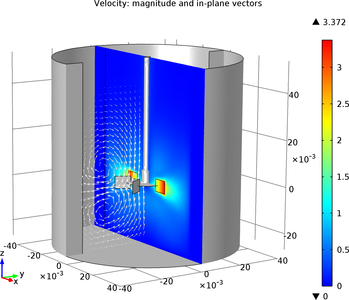
Dieses Modell bietet Ihnen die Möglichkeit, eine Vielzahl von Mischern zu bauen, indem Sie zwei gängige Gefäßtypen mit zwei Rührwerkstypen kombinieren. Die Mischer sind mit Schikanen versehene Behälter mit flachem und gewölbtem Boden und entweder mit Schaufelrädern oder Rushton-Turbinen. ... Mehr lesen

This is a benchmark model for rigid body dynamics. This model simulates the dynamic behavior of "Andrew’s squeezing mechanism", which is force driven and requires a very small time scale. Various angles in the mechanism are compared with the results from the reference. Mehr lesen
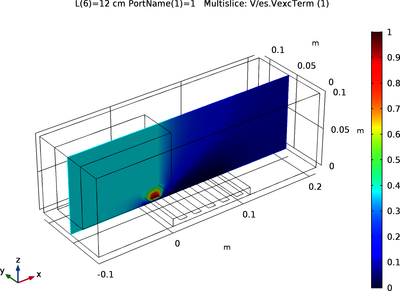
This tutorial model explains how to extract lumped matrices by means of the Stationary Source Sweep study. The capacitance matrix of a five-terminal system is used to infer the position of a metallic object similar to real-world capacitive position sensors. The example illustrates the ... Mehr lesen
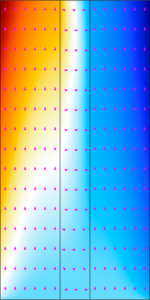
This tutorial demonstrates how to modify a concentration-independent (also known as a secondary current distribution) liquid alkaline water electrolyzer with concentrated electrolyte theory to explicitly resolve local electrolyte and solvent concentrations (thereby creating a tertiary ... Mehr lesen
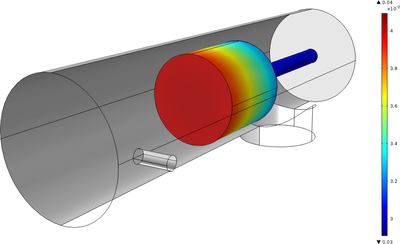
Chemical vapor deposition (CVD) is a process often used in the semiconductor industry to grow layers of high-purity solid material on top of a wafer substrate. CVD is achieved using many different techniques and across a range of pressures from atmospheric to ultrahigh vacuum (UHV/CVD). ... Mehr lesen


