
Die Application Gallery bietet COMSOL Multiphysics® Tutorial- und Demo-App-Dateien, die für die Bereiche Elektromagnetik, Strukturmechanik, Akustik, Strömung, Wärmetransport und Chemie relevant sind. Sie können diese Beispiele als Ausgangspunkt für Ihre eigene Simulationsarbeit verwenden, indem Sie das Tutorial-Modell oder die Demo-App-Datei und die dazugehörigen Anleitungen herunterladen.
Suchen Sie über die Schnellsuche nach Tutorials und Apps, die für Ihr Fachgebiet relevant sind. Beachten Sie, dass viele der hier vorgestellten Beispiele auch über die Application Libraries zugänglich sind, die in die COMSOL Multiphysics® Software integriert und über das Menü File verfügbar sind.

The present model example is based on Copper Deposition in a Trench model available in Electrodeposition Application Library. The nonuniform deposition along the trench surface leads to formation of a cavity/void. Since the Deformed Geometry interface cannot handle topological changes, ... Mehr lesen
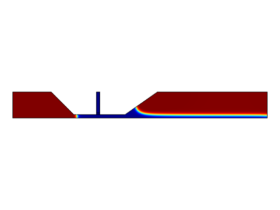
This tutorial shows how to model a slot die coating process with a power-law non-Newtonian fluid in one of the two phases. The model uses a two-phase flow phase-field method. Mehr lesen
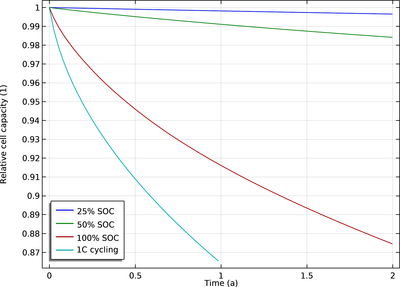
This tutorial demonstrates the Lumped Battery interface for modeling capacity loss in a battery. A set of lumped parameters are used to describe the capacity loss that occurs due to parasitic reactions in the battery, assuming no knowledge of the internal structure or design of the ... Mehr lesen
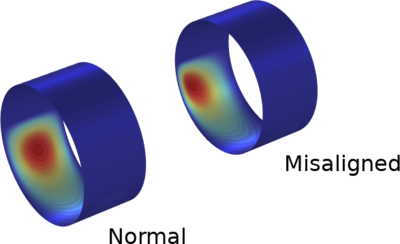
In this example, a rotor supported by two hydrodynamic bearings is analyzed. An eccentric disk located between the bearings induces rotor whirl. One of the bearings is misaligned with the rotor axis. The Beam Rotor interface with Hydrodynamic Bearing interface in the Rotordynamics ... Mehr lesen
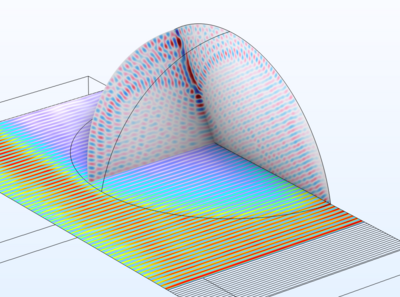
Wird ein Tropfen auf ein Substrat aufgebracht, auf dem sich akustische Oberflächenwellen ausbreiten, wird deren Energie in den Tropfen übertragen und erzeugt ein akustisches Feld. Die übertragene Energie wird gedämpft und führt zu einer Strömung. Diese Strömung ermöglicht eine ... Mehr lesen
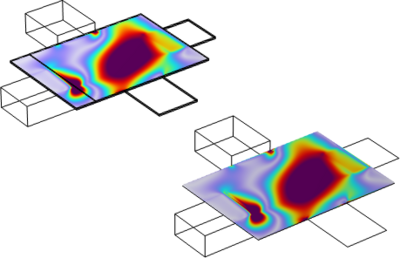
Layered shell elements, which are used for modeling composite shells, often connected to solid and shell elements in a cladding or side-by-side configuration to represent a realistic structure. For such applications, it becomes important to connect layered shell element correctly and ... Mehr lesen
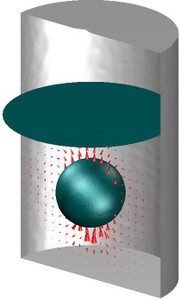
Die Level-Set-Methode eignet sich gut für Probleme mit beweglichen Rändern, bei denen sich die Topologie der Geometrie mit der Zeit ändert. Eine Ölblase, die sich durch das Wasser nach oben bewegt und schließlich mit dem Öl an der Oberfläche verschmilzt, verursacht diese Art von ... Mehr lesen
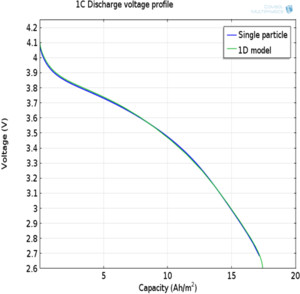
An isothermal single particle model formulation for a lithium-ion battery is presented in this work. The single particle model is a simplification of the 1D formulation for a lithium-ion battery along with a few assumptions. The model is typically valid for low-medium current scenarios. ... Mehr lesen


