
Die Application Gallery bietet COMSOL Multiphysics® Tutorial- und Demo-App-Dateien, die für die Bereiche Elektromagnetik, Strukturmechanik, Akustik, Strömung, Wärmetransport und Chemie relevant sind. Sie können diese Beispiele als Ausgangspunkt für Ihre eigene Simulationsarbeit verwenden, indem Sie das Tutorial-Modell oder die Demo-App-Datei und die dazugehörigen Anleitungen herunterladen.
Suchen Sie über die Schnellsuche nach Tutorials und Apps, die für Ihr Fachgebiet relevant sind. Beachten Sie, dass viele der hier vorgestellten Beispiele auch über die Application Libraries zugänglich sind, die in die COMSOL Multiphysics® Software integriert und über das Menü File verfügbar sind.
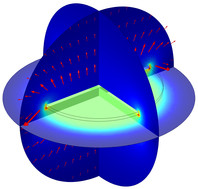
A typical capacitor is composed of two conductive objects with a dielectric in between them. A voltage difference applied between these objects results in an electric field between them. This electric field exists not just directly between the conductive objects, but extends some ... Mehr lesen
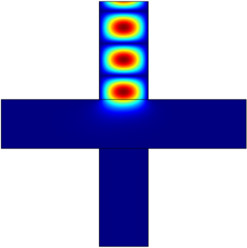
Wave heated discharges may be very simple, where a plane wave is guided into a reactor using a waveguide, or very complicated as in the case with ECR (electron cyclotron resonance) reactors. In this example, a wave is launched into reactor and an Argon plasma is created. The wave is ... Mehr lesen

This model simulates electrical breakdown in an atmospheric pressure gas. Modeling dielectric barrier discharges in more than one dimension is possible, but the results can be difficult to interpret because of the amount of competing physics in the problem. In this simple model the ... Mehr lesen
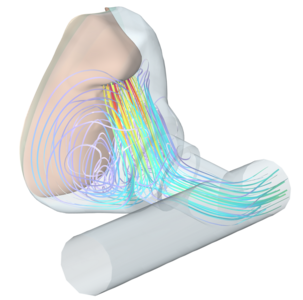
Bei der Entwicklung von Sauerstoffmasken für die Atemunterstützung von Patienten mittels BiPAP und CPAP hilft die Multiphysik-Modellierung dabei, das Strömungsmuster im Inneren der Maske für ein bestimmtes Design zu visualisieren. Auf dieser Grundlage können Sie den Sauerstoffverbrauch, ... Mehr lesen

Computing molecular flows in arbitrary geometries produces complex integral equations that are very difficult to compute analytically. Analytic solutions are, therefore, only available for simple geometries. One of the earliest problems solved was that of gas flow through tubes of ... Mehr lesen
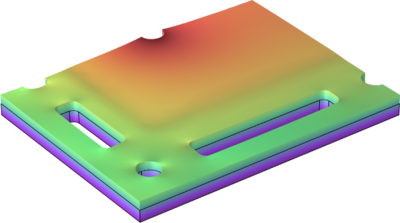
A fuel cell stack operates at temperatures just below 100 °C, which means that it has to be heated at start-up. The fuel cell stack consists of unit cell of anode, membrane, and cathode connected in series through bipolar plates. This study presents a model that couples the thermal and ... Mehr lesen
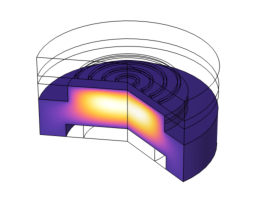
This tutorial model solves for an inductively coupled plasma reactor with RF bias (also known as ICP/CCP reactors) in a mixture of argon/chlorine. The model computes the fluid flow and gas heating. Important aspects and strategies for modeling electronegative discharges are discussed. Mehr lesen
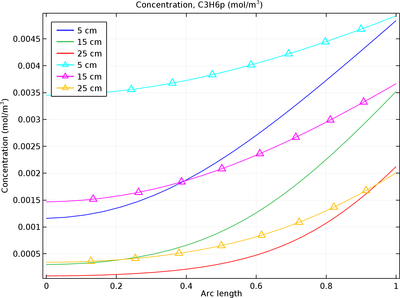
One of the most common reactors in the chemical industry, for use in heterogeneous catalytic processes, is the packed bed reactor. This type of reactor is used both in synthesis as well as in effluent treatment and catalytic combustion. The reactor consists in essence of a container ... Mehr lesen

Recovery of precious metals in recycling of electronics, or extraction from ore, is usually performed through leaching of the metal into an aqueous phase. Precious metals require the use of an oxidant, and often, a complexant. In the case of gold, the cyanide anion (CN-) forms a soluble ... Mehr lesen

Nucleate boiling occurs when a liquid is heated by a source hotter than the saturated fluid temperature but with a heat flux below the critical heat flux. In this regime, high heat flux are possible due to the evaporation of the liquid. This model aims to demonstrate the calculation of ... Mehr lesen