
Die Application Gallery bietet COMSOL Multiphysics® Tutorial- und Demo-App-Dateien, die für die Bereiche Elektromagnetik, Strukturmechanik, Akustik, Strömung, Wärmetransport und Chemie relevant sind. Sie können diese Beispiele als Ausgangspunkt für Ihre eigene Simulationsarbeit verwenden, indem Sie das Tutorial-Modell oder die Demo-App-Datei und die dazugehörigen Anleitungen herunterladen.
Suchen Sie über die Schnellsuche nach Tutorials und Apps, die für Ihr Fachgebiet relevant sind. Beachten Sie, dass viele der hier vorgestellten Beispiele auch über die Application Libraries zugänglich sind, die in die COMSOL Multiphysics® Software integriert und über das Menü File verfügbar sind.

Wenn elektrische Energie in einem Elektromotor in mechanische Arbeit umgewandelt wird, wird die "verschwendete" Energie, die zur Erwärmung des Geräts führt, gewöhnlich als Verlust bezeichnet. Das Verhältnis von nutzbarer Arbeit zu eingegebener Energie, oder der Wirkungsgrad des Motors, ... Mehr lesen
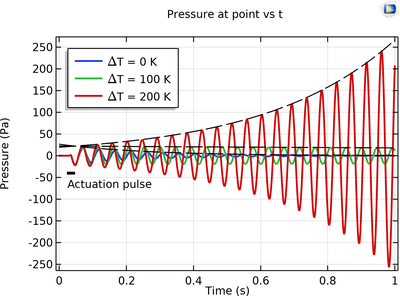
Dies ist ein Modell eines einfachen thermoakustischen Motors, der einen thermischen Stack zur Umwandlung von Wärmeenergie in akustische Energie enthält. Das Modell wird mit zwei Ansätzen aufgebaut: 1) Mit einem linearen Störungsansatz (akustisch) wird die Fluidbewegung mit dem Interface ... Mehr lesen
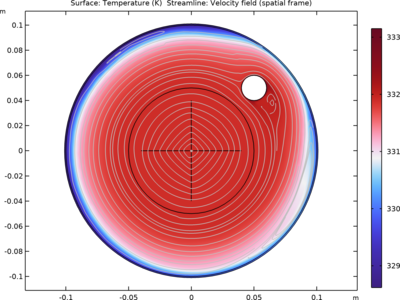
This model illustrates the modeling of temperature distribution in a simplified mixer. Mehr lesen
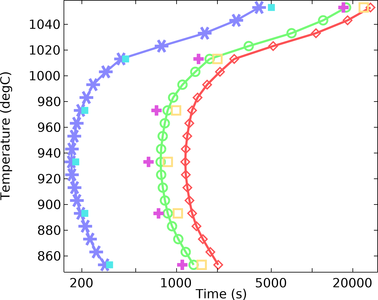
This model shows how to use the Metal Processing Module and the Optimization Module to calibrate parameters of a phase transformation model against TTT (Time Temperature Transformation) data. Mehr lesen
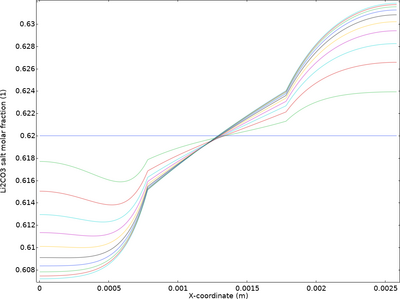
This tutorial shows how to model transport of the individual ions in a salt melt comprising two binary salts, where the transport equations are defined using concentrated solution theory. The example model defines a molten carbonate fuel cell (or electrolyzer), with a 1D-model geometry ... Mehr lesen
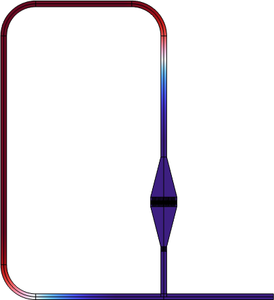
The models simulate the working mechanism of traveling wave thermoacoustic engines. Similary to the standing wave engines, the traveling wave engines make use of the coupling between the fluid motion and the temperature change experienced by the fluid to generate acoustic energy. ... Mehr lesen

This example shows how to set up a glacier flow model in principle, containing several important aspects of glacier modeling: The creation of the 2D geometry, the modeling of non-Newtonian flow, and the implementation of basal sliding. In this example, two different glacier types, a cold ... Mehr lesen
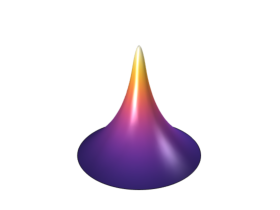
This classical verification model solves the steady state temperature distribution in a plan disk heated by a localized heat source at its center. It shows and compare different ways to define a heat source localized on a small domain by representing it either as a geometrical point or a ... Mehr lesen
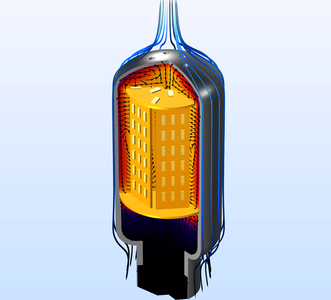
This model describes the three heat transfer modes: conduction, convection, and radiation, combined with nonisothermal flow in a realistic geometry representing a light bulb and the surrounding air. The LED chips dissipate heat. The model computes the equilibrium temperature induced by ... Mehr lesen
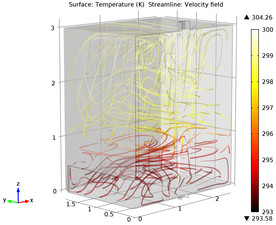
In general, there are two classes of ventilation: mixing ventilation and displacement ventilation. In displacement ventilation, air enters a room at the floor level and displaces warmer air to achieve the desired temperature. Heating sources in the room can include running electronic ... Mehr lesen