
Die Application Gallery bietet COMSOL Multiphysics® Tutorial- und Demo-App-Dateien, die für die Bereiche Elektromagnetik, Strukturmechanik, Akustik, Strömung, Wärmetransport und Chemie relevant sind. Sie können diese Beispiele als Ausgangspunkt für Ihre eigene Simulationsarbeit verwenden, indem Sie das Tutorial-Modell oder die Demo-App-Datei und die dazugehörigen Anleitungen herunterladen.
Suchen Sie über die Schnellsuche nach Tutorials und Apps, die für Ihr Fachgebiet relevant sind. Beachten Sie, dass viele der hier vorgestellten Beispiele auch über die Application Libraries zugänglich sind, die in die COMSOL Multiphysics® Software integriert und über das Menü File verfügbar sind.
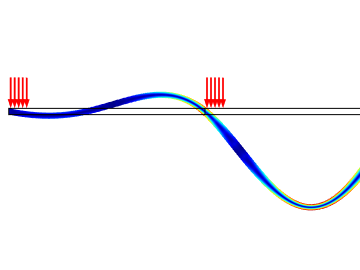
Dieses Beispiel zeigt, wie Sie eine räumlich und zeitlich variierende Last modellieren können. Eine Reihe von Lastimpulsen bewegt sich entlang eines Balkens, der in gleichen Abständen gestützt wird. Für einige Kombinationen der Laufgeschwindigkeit der Lastimpulse und des Abstands ... Mehr lesen
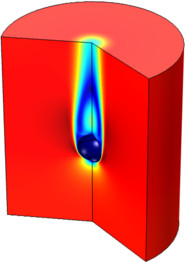
Die erste Station für verschmutztes Wasser, das in ein Wasserwerk gelangt, ist normalerweise ein großer Tank, in dem sich große Partikel absetzen. Im Allgemeinen ist die Schwerkraftabscheidung eine wirtschaftliche Methode zur Abtrennung von Partikeln. Wenn sich das Fluid im Tank mit ... Mehr lesen
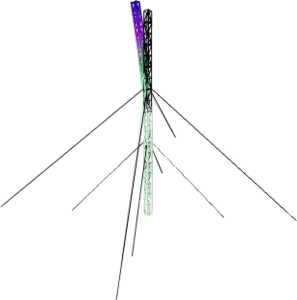
This example shows how to compute the critical buckling load in the presence of dead loads. A truss tower is supported by pretensioned guys. The pretension load and gravity on the truss are considered as dead loads, while the vertical load applied at the top of the tower is considered ... Mehr lesen

When cooking food, such as a patty, in convection ovens there is a trade off in the heating method. If the patty is heated at a low oven temperature the cooking is slow and the patty dries out, resulting in a poor taste. If the patty is heated rapidly at a high temperature, it is ... Mehr lesen
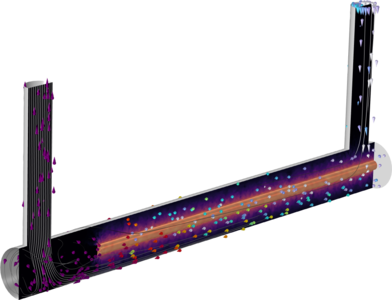
In this example, a simple ultraviolet (UV) water purification reactor is modeled using a combination of ray tracing, computational fluid dynamics, and Lagrangian particle tracking. First, the volumetric fluence rate is accumulated along rays released from the surface of the UV lamp using ... Mehr lesen
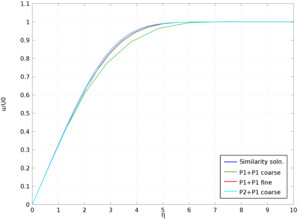
The incompressible boundary layer on a flat plate in the absence of a pressure gradient is usually referred to as the Blasius boundary layer. The steady, laminar boundary layer developing downstream of the leading edge eventually becomes unstable to Tollmien-Schlichting waves and finally ... Mehr lesen
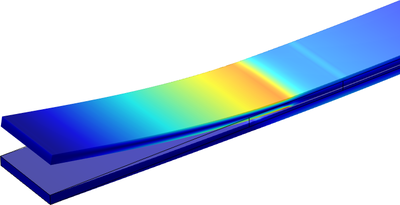
Interfacial failure by delamination or debonding can be simulated with a Cohesive Zone Model (CZM). This example shows the implementation of a CZM with a bilinear traction-separation law. It is used to predict the mixed-mode softening onset and delamination propagation in a composite ... Mehr lesen
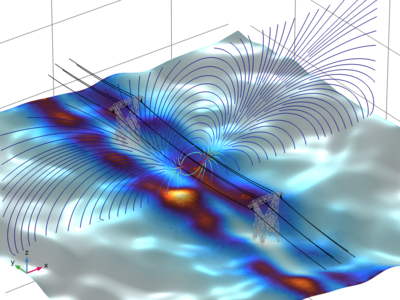
Hochspannungsleitungen werden häufig zur Übertragung von elektrischem Strom über große Entfernungen verwendet. In diesem Tutorial werden Masten modelliert, die dreiphasigen Hochspannungswechselstrom übertragen, und das daraus resultierende elektrische Feld wird berechnet. Die Masten ... Mehr lesen


