
Die Application Gallery bietet COMSOL Multiphysics® Tutorial- und Demo-App-Dateien, die für die Bereiche Elektromagnetik, Strukturmechanik, Akustik, Strömung, Wärmetransport und Chemie relevant sind. Sie können diese Beispiele als Ausgangspunkt für Ihre eigene Simulationsarbeit verwenden, indem Sie das Tutorial-Modell oder die Demo-App-Datei und die dazugehörigen Anleitungen herunterladen.
Suchen Sie über die Schnellsuche nach Tutorials und Apps, die für Ihr Fachgebiet relevant sind. Beachten Sie, dass viele der hier vorgestellten Beispiele auch über die Application Libraries zugänglich sind, die in die COMSOL Multiphysics® Software integriert und über das Menü File verfügbar sind.
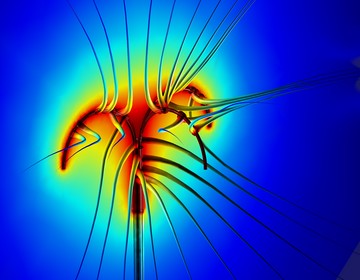
Eine Methode zur Entfernung von Tumoren aus gesundem Gewebe besteht darin, das bösartige Gewebe auf eine kritische Temperatur zu erhitzen, die die Krebszellen abtötet. In diesem Beispiel wird die lokale Erwärmung durch das Einführen einer vierarmigen elektrischen Sonde erreicht, durch ... Mehr lesen
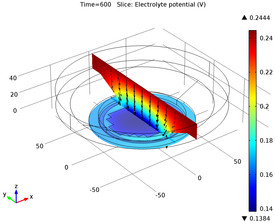
This example models time-dependent copper deposition on a resistive wafer in a cupplater reactor. As the deposited layer builds up, the resistive losses of the deposited layer decreases. The benefit of using a current thief for a more uniform deposit is demonstrated. Mehr lesen
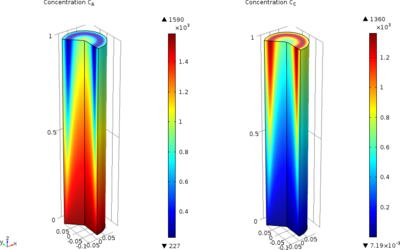
This application uses the Chemical Reaction Engineering Module to study an elementary, exothermic, irreversible reaction in a tubular reactor (liquid phase, laminar flow regime). To keep its temperature down, the reactor uses a cooling jacket with a constant coolant temperature. The ... Mehr lesen
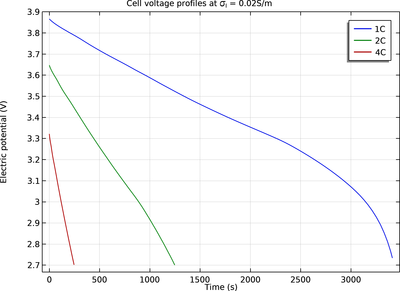
This example demonstrates the Lithium-Ion Battery, Single-Ion Conductor interface for studying the discharge of a lithium-ion battery with solid electrolyte. The geometry is in one dimension and the model is isothermal. The behavior at various discharge currents and solid electrolyte ... Mehr lesen
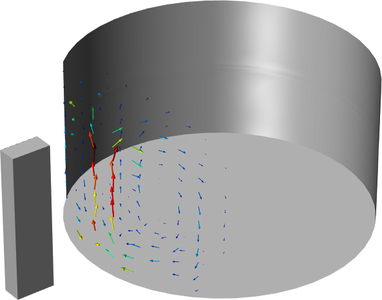
Dies ist eine Anleitung, wie Sie elektrische Maschinen in 3D mit einer Kombination aus den Interfaces Magnetic Fields und Magnetic Fields, No Currents aufbauen können. Mehr lesen

This tutorial performs steady-state and transient analysis of the response of a PIN diode to constant and pulsed radiation, respectively. The effect of radiation is modeled as spatially uniform generation of electron-hole pairs within the device. At high dose rates the separation of the ... Mehr lesen
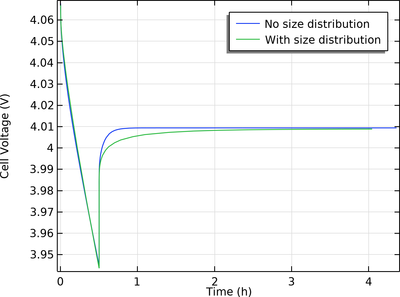
Battery electrodes featuring large heterogeneities in terms of particle sizes may sometimes not be adequately described by homogenized models using one single particle size only. As an alternative to adding multiple instances of the Additional Porous Electrode material node, this ... Mehr lesen
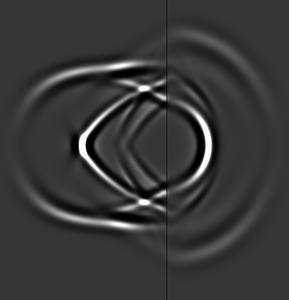
In this 2D tutorial, a test sample consists on one side of an isotropic material and on the other side of a heterogeneous anisotropic material (a transverse anisotropic zinc crystal). Elastic waves in the sample are excited by a point-like force. The model is solved with the Elastic ... Mehr lesen
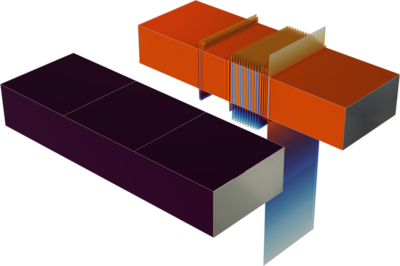
In a diode or a transistor, when a p-n junction is reverse-biased (the p-side is connected to a lower potential than the n-side), ideally, no current should flow. However, due to minority carriers (electrons in the p-side and holes in the n-side), a small current, known as the reverse ... Mehr lesen
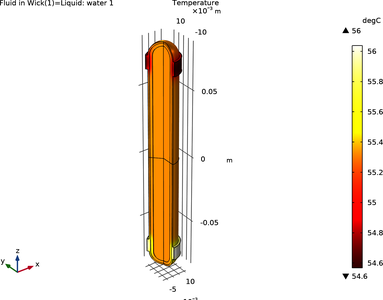
Wärmerohre sind für den effizienten Wärmetransport durch Verdampfung, Stoffaustausch und Kondensation eines Fluids konzipiert. Sie kommen in einer Vielzahl von Anwendungen zum Einsatz, bei denen die Wärmeregulierung von Bedeutung ist, zum Beispiel bei der Kühlung von Elektronik. In ... Mehr lesen


