
Die Application Gallery bietet COMSOL Multiphysics® Tutorial- und Demo-App-Dateien, die für die Bereiche Elektromagnetik, Strukturmechanik, Akustik, Strömung, Wärmetransport und Chemie relevant sind. Sie können diese Beispiele als Ausgangspunkt für Ihre eigene Simulationsarbeit verwenden, indem Sie das Tutorial-Modell oder die Demo-App-Datei und die dazugehörigen Anleitungen herunterladen.
Suchen Sie über die Schnellsuche nach Tutorials und Apps, die für Ihr Fachgebiet relevant sind. Beachten Sie, dass viele der hier vorgestellten Beispiele auch über die Application Libraries zugänglich sind, die in die COMSOL Multiphysics® Software integriert und über das Menü File verfügbar sind.
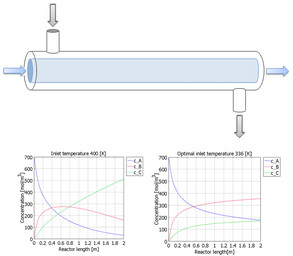
Maximizing product yield is a main task in chemical reaction engineering. This can be especially challenging if the desired product, once formed, can be consumed by further reactions. This example investigates such a series reaction as it occurs in a tubular reactor. You will start by ... Mehr lesen
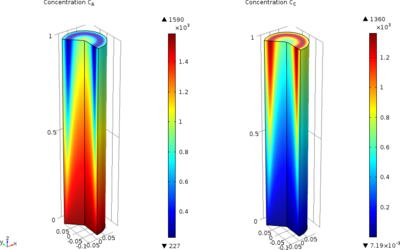
This application uses the Chemical Reaction Engineering Module to study an elementary, exothermic, irreversible reaction in a tubular reactor (liquid phase, laminar flow regime). To keep its temperature down, the reactor uses a cooling jacket with a constant coolant temperature. The ... Mehr lesen

As integrated circuit (IC) technology advances, with circuits becoming more powerful and compact, it is increasingly important to identify and prevent any cause of circuit failure. One particularly critical factor contributing to circuit failure is electromigration within the ... Mehr lesen
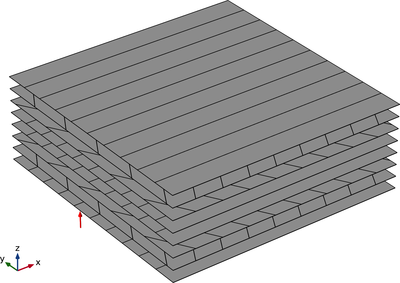
This model serves the purpose of validation and verification of the Linear Elastic Material, Layered model in the Shell interface. In COMSOL Multiphysics, composites are analyzed either based on Layerwise 3D elasticity theory through the Layered Shell interface or based on FSDT-ESL ... Mehr lesen

This model approximates 3D spherical transport using a 1D model. Many models of industrial-transport problems allow the assumption that the problem is spherically symmetric. This assumption is of great importance because it eliminates two space coordinates to result in a 1D problem that ... Mehr lesen
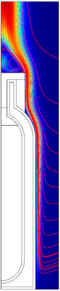
Das folgende Beispiel löst ein reines Konduktions- und ein freies Konvektionsproblem, bei dem eine Thermoskanne mit heißem Kaffee Wärmeenergie abgibt. Das Hauptinteresse besteht darin, die Kühlleistung der Thermoskanne zu berechnen, d.h. wie viel Wärme sie pro Zeiteinheit verliert. In ... Mehr lesen
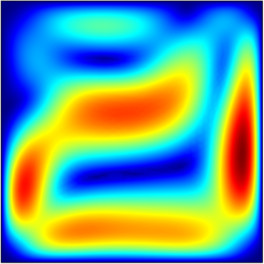
In diesem Beispiel geht es um die Modellierung einer unterirdischen Strömung, bei der die freie Konvektion in porösen Medien analysiert wird. Die Ergebnisse werden mit der veröffentlichten Literatur auf diesem Gebiet verglichen. Das Modell koppelt die Impulsbilanz mit einer ... Mehr lesen
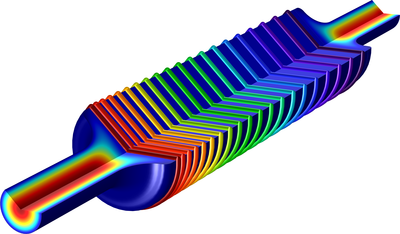
Carbon deposition on the surface of solid catalysts is commonly observed in hydrocarbon processing. A known problem is that carbon deposits can impede the activity of catalysts as well as block the flow of gas through a catalyst bed. This example investigates the thermal decomposition ... Mehr lesen
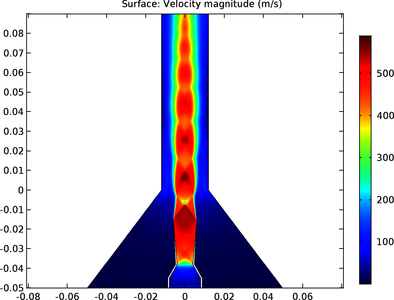
In this study, the compressible turbulent flow through a supersonic ejector is modeled using the High Mach Number Flow interface in the CFD Module. Ejectors are simple mechanical components used for a wide range of applications, including industrial refrigeration, vacuum generation, gas ... Mehr lesen

Large FEM simulations can be costly and, if repeated simulations are needed, it can be beneficial to use reduced-order models (ROMs). ROMs are typically valid only in the vicinity of their design conditions and have lower accuracy, but the simulation time is significantly shorter. The ... Mehr lesen