
Die Application Gallery bietet COMSOL Multiphysics® Tutorial- und Demo-App-Dateien, die für die Bereiche Elektromagnetik, Strukturmechanik, Akustik, Strömung, Wärmetransport und Chemie relevant sind. Sie können diese Beispiele als Ausgangspunkt für Ihre eigene Simulationsarbeit verwenden, indem Sie das Tutorial-Modell oder die Demo-App-Datei und die dazugehörigen Anleitungen herunterladen.
Suchen Sie über die Schnellsuche nach Tutorials und Apps, die für Ihr Fachgebiet relevant sind. Beachten Sie, dass viele der hier vorgestellten Beispiele auch über die Application Libraries zugänglich sind, die in die COMSOL Multiphysics® Software integriert und über das Menü File verfügbar sind.
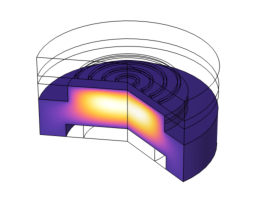
This tutorial model solves for an inductively coupled plasma reactor with RF bias (also known as ICP/CCP reactors) in a mixture of argon/chlorine. The model computes the fluid flow and gas heating. Important aspects and strategies for modeling electronegative discharges are discussed. Mehr lesen
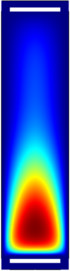
Gleichstrom-Glimmentladungen im Niederdruckbereich werden seit langem für Gaslaser und Leuchtstofflampen verwendet. Gleichstromentladungen sind für die Untersuchung attraktiv, weil die Lösung zeitunabhängig ist. Die 1D- und 2D-Modelle zeigen, wie Sie das Interface DC Discharge verwenden ... Mehr lesen

This tutorial model solves for an inductively coupled plasma reactor in a mixture of argon/oxygen. The model computes the fluid flow and gas heating. Important aspects and strategies for modeling electronegative discharges are discussed. Mehr lesen
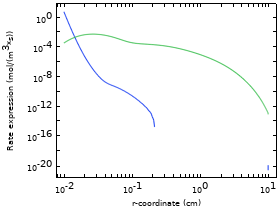
This tutorial presents a study of positive and negative corona discharges in dry air at atmospheric pressure. The discharges are sustained within two electrodes in a coaxial configuration by a high voltage DC source applied to the inner electrode. Two different types of models are used: ... Mehr lesen
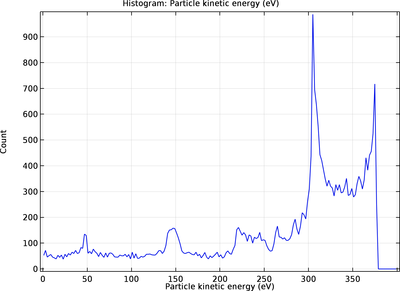
This model computes the ion energy distribution function (IEDF) for a commercial capacitively coupled plasma reactor. The results show good agreement with experimental data. Mehr lesen
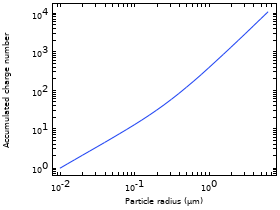
This model computes the fluid flow, charge transport and electric potential in an electrostatic precipitator. Based on the resulting fields, particles of different diameter are fed into the device and the transmission probability is computed. As expected, the separation efficiency shows ... Mehr lesen

The GEC cell was introduced by NIST in order to provide a standardized platform for experimental and modeling studies of discharges in different laboratories. The plasma is sustained via inductive heating. The Reference Cell operates as an inductively-coupled plasma in this model. This ... Mehr lesen
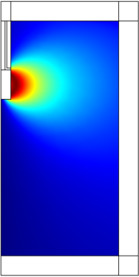
This model presents a 2D axisymmetric dipolar microwave plasma source sustained through resonant heating of the electrons. This is known as electron cyclotron resonance (ECR), which occurs when a suitable high magnetic flux density is present along with the microwaves. This is an ... Mehr lesen

This model investigates the electrical and thermal characteristics of an inductively coupled plasma torch at atmospheric pressure. The discharge is assumed to be in local thermodynamic equilibrium. Mehr lesen
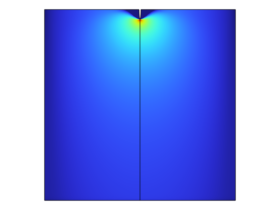
This tutorial model presents a study of a negative corona discharge in dry air at atmospheric pressure in a point-to-plane configuration. An elliptical electrode with millimeter dimensions creates a high intensity electric field where the corona discharge occurs. A ground plane is placed ... Mehr lesen


