
Die Application Gallery bietet COMSOL Multiphysics® Tutorial- und Demo-App-Dateien, die für die Bereiche Elektromagnetik, Strukturmechanik, Akustik, Strömung, Wärmetransport und Chemie relevant sind. Sie können diese Beispiele als Ausgangspunkt für Ihre eigene Simulationsarbeit verwenden, indem Sie das Tutorial-Modell oder die Demo-App-Datei und die dazugehörigen Anleitungen herunterladen.
Suchen Sie über die Schnellsuche nach Tutorials und Apps, die für Ihr Fachgebiet relevant sind. Beachten Sie, dass viele der hier vorgestellten Beispiele auch über die Application Libraries zugänglich sind, die in die COMSOL Multiphysics® Software integriert und über das Menü File verfügbar sind.

One of the ways we can simplify and reduce the size and computational complexity of a finite element model is by using any symmetries present in a model. In this entry, you can find three practical examples highlighting how to exploit symmetries in RF or wave optics modeling. They all ... Mehr lesen
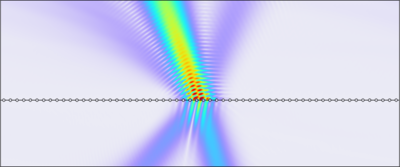
This shows how a Gaussian beam incident on a periodic structure can be efficiently simulated. This could be applied to structured surfaces like metasurfaces or diffraction gratings. Because of superposition, only a single unit cell needs to be simulated. This can provide extremely ... Mehr lesen
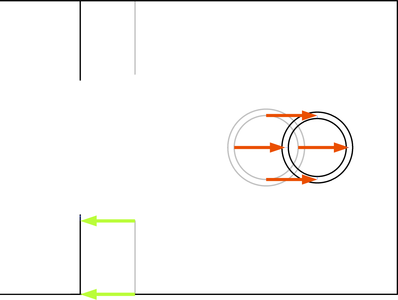
This model demonstrates how to find the optimal size and position of a water pipe in an air chamber, so that the energy absorption in the water is maximized. The objective is implemented as a constraint, so that the optimization terminates, when the desired performance is achieved. Mehr lesen
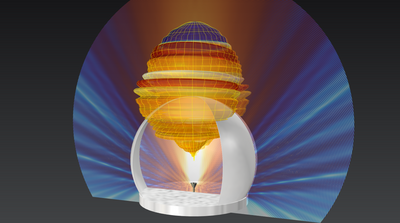
This model demonstrates an efficient approach to simulating a thin, spherical, large radome using a 2D axisymmetric formulation with cubic discretization. The axisymmetric method captures full 3D behavior for azimuthally symmetric geometries at only a fraction of the computational cost. ... Mehr lesen
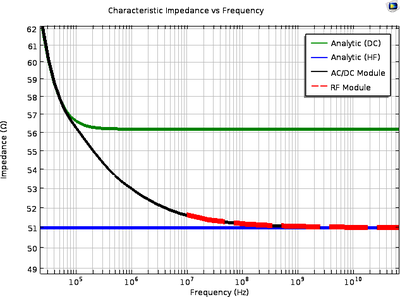
Electrical cables, also called transmission lines, are used everywhere in the modern world to transmit both power and data. These cables carry electromagnetic energy, but instead of dealing with the full complexity of the electromagnetic fields, they are more commonly classified ... Mehr lesen

A plane electromagnetic wave is incident on a metallic sphere partially embedded on a substrate. In this electromagnetic scattering problem, the far-field variables are computed for a few elevation angles of incidence. Mehr lesen
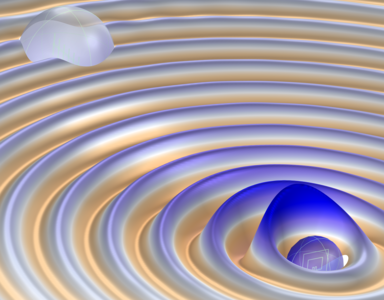
In this model, the transmitter (microstrip patch) and receiver (Yagi–Uda) antennas are modeled simultaneously in the FEM domain and are coupled with FEM–BEM coupling. The results are compared with the analytical Friis transmission formula. In detail, the emw and emw2 interfaces find out ... Mehr lesen
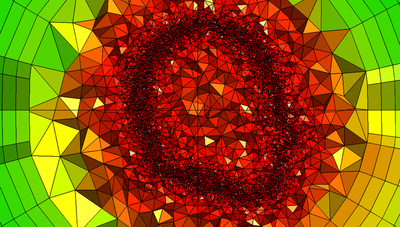
Creating irregular geometries can be a good solution, even the only option, for some types of applications. These files present a way to use a text file with material properties defined in coordinates to assign different materials even though there is only one regular domain. The same ... Mehr lesen
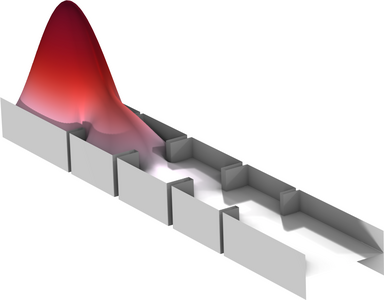
A waveguide filter is designed using shape optimization by moving and scaling rectangles in the geometry. The irises of the initial geometry are optimized to ensure good bandpass response and out-of-band rejection, while maintaining the double mirror symmetry. The EGO optimization solver ... Mehr lesen

In food industries, microwave heating is gaining attention over a conventional heating treatment because of several advantages such as precise process control, speed of heating, fast turn-on and turn-off time, etc. In this model, a high directional Yagi-Uda antenna is used to heat up ... Mehr lesen


