
Sehen Sie, wie die Multiphysik-Simulation in verschiedenen Branchen eingesetzt wird
Multiphysik-Modellierung und -Simulation treiben Innovationen in Industrie und Wissenschaft voran – wie die zahlreichen Anwendungsbeispiele zeigen, die jedes Jahr in den Fachbeiträgen und Postern von Ingenieuren, Forschern und Wissenschaftlern auf der COMSOL Conference vorgestellt werden. Lassen Sie sich von den unten aufgeführten aktuellen Beiträgen inspirieren oder nutzen Sie die Schnellsuche, um eine bestimmte Präsentation zu finden oder nach Anwendungsbereich oder Konferenzjahr/-ort zu filtern.
Sehen Sie sich die Kollektion für die COMSOL Conference 2024 an
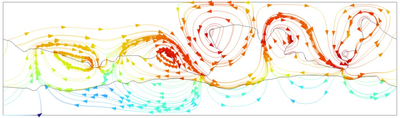
Modern composite membranes for reverse osmosis (RO) and nanofiltration (NF) have an ultrathin polyamide active layer (~100 nm) that performs the ion separation. Current theoretical models explain solute and water fluxes by computing concentration and potential gradients developed in one ... Mehr lesen
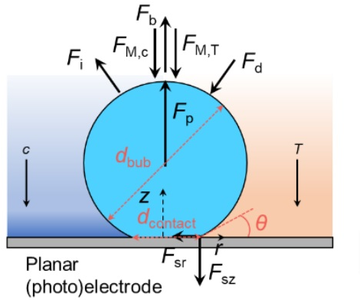
Many (photo)electrolytic devices involve the generation of bubbles (e.g., hydrogen, oxygen). In these devices, bubble coverage on the surface of the electrode not only decreases the active area, but also induces optical loss.[1,2] Efforts in understanding the bubble detachment process ... Mehr lesen
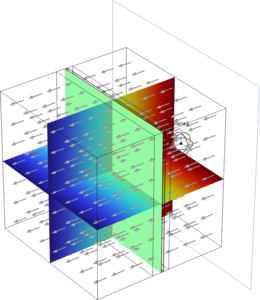
Alkaline Electrolysis (AEL) technology is known and used in industries for half a century. It is a key technology for large-scale hydrogen production powered by renewable energy for example chemical industries. Flows of 99.999% pure hydrogen up to 20’000 Nm³/h with an electrical power of ... Mehr lesen
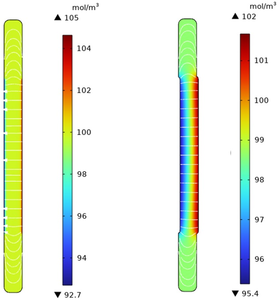
Product lifetime prediction is a crucial task in microelectronics design and fabrication. Understanding of the underlying processes causing material degradation and product failure is essential for establishing accurate lifetime models. This work aims to investigate and model the ... Mehr lesen
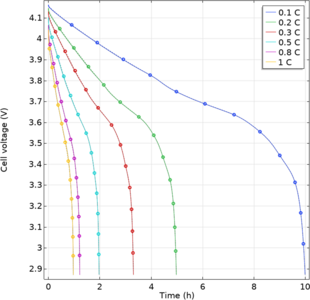
For modeling battery simulation, material properties and simulation parameters such as electrical conductivity, diffusion coefficient, volume ratio of electrodes / electrolytes, exchange current density and electrode particle radius are required. Though these kinds information can be ... Mehr lesen

Electrochemical Impedance Spectroscopy (EIS) is a technique commonly used to investigate the properties of the electrode surface and the bulk electrolyte in an electrochemical cell [1]. An AC excitation signal is applied with a frequency range, typically from 0.01 Hz to 1 MHz, and the ... Mehr lesen
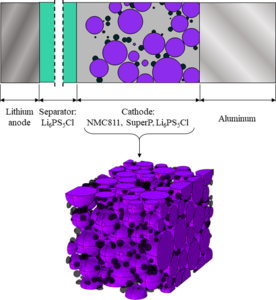
Solid-state batteries have emerged as a viable alternative to traditional liquid-based lithium-ion batteries, offering improved cost efficiency, safety, and environmental impact. Chlorine-rich lithium argyrodite (Li6PS5Cl) has emerged as a promising solid-state electrolyte, presenting ... Mehr lesen
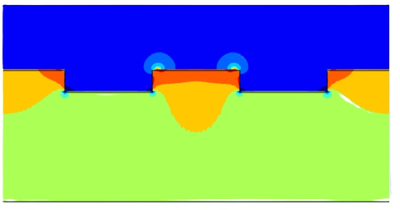
The advancement of battery technology plays a crucial role in achieving sustainable and electrified future with efficient energy storage. In recent years, all-solid-state lithium-ion batteries (ASSLIBs) have shown great potential, offering higher capacity, enhanced safety, and longer ... Mehr lesen
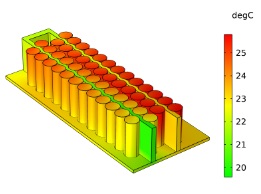
The development of batteries for automotive application is progressing rapidly. It goes hand in hand with a rising demand for scarce raw materials. Diversification of cell chemistries is a promising approach to respond to market fluctuations and at the same time minimize system costs. A ... Mehr lesen
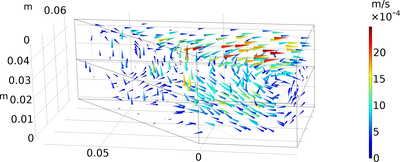
The throwing power is an important criterion for the industrial use of an electrolyte in electroplating applications. Using the Electrodeposition Module and COMSOL Multiphyiscs® it is possible to simulate the thickness distribution for various electroplating geometries. For a realistic ... Mehr lesen


