
Sehen Sie, wie die Multiphysik-Simulation in verschiedenen Branchen eingesetzt wird
Multiphysik-Modellierung und -Simulation treiben Innovationen in Industrie und Wissenschaft voran – wie die zahlreichen Anwendungsbeispiele zeigen, die jedes Jahr in den Fachbeiträgen und Postern von Ingenieuren, Forschern und Wissenschaftlern auf der COMSOL Conference vorgestellt werden. Lassen Sie sich von den unten aufgeführten aktuellen Beiträgen inspirieren oder nutzen Sie die Schnellsuche, um eine bestimmte Präsentation zu finden oder nach Anwendungsbereich oder Konferenzjahr/-ort zu filtern.
Sehen Sie sich die Kollektion für die COMSOL Conference 2024 an
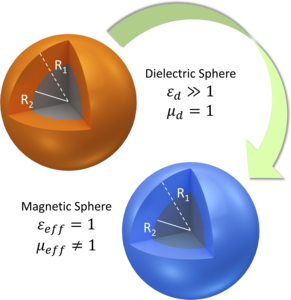
The pursuit of artificial magnetism within metamaterials research has long been a focal point. Traditional methods rely on analyzing complex configurations such as arrays of subwavelength particles or split-rings, but unfortunately they fail at subwavelength scales. Revisiting Mie theory ... Mehr lesen
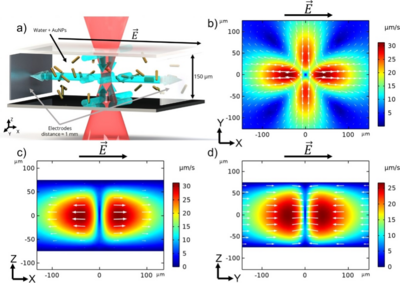
Efficient mixing and pumping of liquids at the microscale is a technology that is still to be optimized. The combination of an AC electric field with a small temperature gradient leads to a strong electrothermal flow that can be used for multiple purposes. Combining simulations and ... Mehr lesen
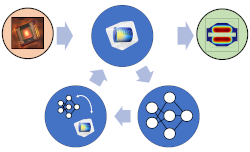
In the rapid development cycle of sensor systems, minimizing time-to-market is crucial. However, designing a new MEMS-chip (Micro-Electro-Mechanical Systems) presents significant challenges due to the extensive time required for manufacturing and characterization. This delay affects the ... Mehr lesen

Quasi-static 2D-MEMS vector scanners are micro-opto-electro-mechanical systems (MOEMS) made of monocrystalline silicon. The primary application for these controllable micromirrors is the high dynamic and precise deflection of laser beams, for example in light detection and ranging ... Mehr lesen
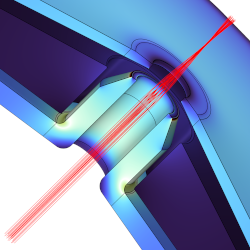
In order to facilitate semiconductor production in the upcoming technology nodes (3nm, 2nm, 14A) our state-of-the-art multi beam mask writer (MBMW) needs constant improvement in throughput and writing precision. As these two goals contradict each other, adaption of the electron optical ... Mehr lesen
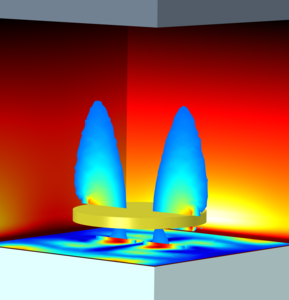
The goal of this study is to exploit the phase change in vanadium dioxide (VO₂) for optical sensing. Infrared (IR) sensing is of paramount interest for next-generation Internet of Things (IoT) devices. Phase change materials (PCMs) are expected to enable low-energy consumption sensors, ... Mehr lesen


