
Sehen Sie, wie die Multiphysik-Simulation in verschiedenen Branchen eingesetzt wird
Multiphysik-Modellierung und -Simulation treiben Innovationen in Industrie und Wissenschaft voran – wie die zahlreichen Anwendungsbeispiele zeigen, die jedes Jahr in den Fachbeiträgen und Postern von Ingenieuren, Forschern und Wissenschaftlern auf der COMSOL Conference vorgestellt werden. Lassen Sie sich von den unten aufgeführten aktuellen Beiträgen inspirieren oder nutzen Sie die Schnellsuche, um eine bestimmte Präsentation zu finden oder nach Anwendungsbereich oder Konferenzjahr/-ort zu filtern.
Sehen Sie sich die Kollektion für die COMSOL Conference 2024 an
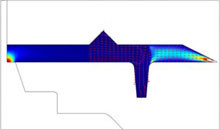
In this work we tackle a more theoretical aspect of micro-injection molding, to better understand physics during the process, through numerical simulations of cavity filling. We developed a two phase flow approach by the use of COMSOL Multiphysics®. In a first step, a Level Set model is ... Mehr lesen
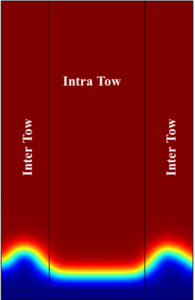
Resin Transfer Molding (RTM), is a closed mold reinforced polymer composite molding process where the resin is infused under a pressure gradient. The liquid resin is infused through the dry preform and displaces air to saturate the preform. One of the governing parameters in an RTM ... Mehr lesen

We have chosen droplet-based microfluidics as a platform for single cell analysis using the encapsulation technique. For this, we study the water in oil droplets formation inside a 2D microfluidic flow focusing geometry designed. We have performed Computational Fluid Dynamics (CFD) ... Mehr lesen

The nanofluid is a class of fluids with high thermal conductivity and non-Newtonian flow behaviors. In this work, we present numerical simulations of spreading characteristics for nanofluids droplet impinging on the solid surface which is of great importance in a number of applications ... Mehr lesen

Impact of human activities on the climate is evident, and the recent anthropogenic production and discharge of greenhouse gases into the atmosphere is highest in history. The current climate change have had worldwide influence on human and natural systems for example; global warming, ... Mehr lesen

In-situ electrical heating technologies are among the most recent technologies used for bitumen recovery from tar sand and oil shale. These technologies have limited environmental impact because there is little disturbance of the land, and water and solvents are not used. Two-phase ... Mehr lesen
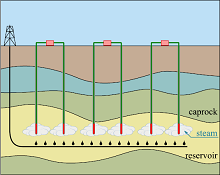
The efficiency and environmental impact of oil production become a principal challenge of energy producing companies. The improvement of existing and development of novel methods are often feasible within either a “new” physical framework (from the viewpoint of oil reservoir ... Mehr lesen

CO2 capture and storage constitutes a promising solution to control and reduce these emissions. Wellbore integrity is a key challenge to ensure long term safety and for public acceptance. For this objective, a two-phase flow model in porous media based on Darcy’s law has been proposed to ... Mehr lesen

Droplet generation in microfluidics is a powerful technique to get monodispersed emulsions and droplet size manipulation can be very advantageous in a wide area of applications such as pharmaceuticals, drug delivery, food products, chemical synthesis and biomedical applications. In the ... Mehr lesen
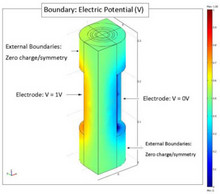
A beneficial method for transporting highly viscous hydrocarbons (e.g. heavy oil and bitumen) through a pipeline is known as Lubricated Pipe Flow (LPF). A major challenge for this technology is flow instability caused by the formation of a wall-coating of oil or the thinning and/or loss ... Mehr lesen


