
Sehen Sie, wie die Multiphysik-Simulation in verschiedenen Branchen eingesetzt wird
Multiphysik-Modellierung und -Simulation treiben Innovationen in Industrie und Wissenschaft voran – wie die zahlreichen Anwendungsbeispiele zeigen, die jedes Jahr in den Fachbeiträgen und Postern von Ingenieuren, Forschern und Wissenschaftlern auf der COMSOL Conference vorgestellt werden. Lassen Sie sich von den unten aufgeführten aktuellen Beiträgen inspirieren oder nutzen Sie die Schnellsuche, um eine bestimmte Präsentation zu finden oder nach Anwendungsbereich oder Konferenzjahr/-ort zu filtern.
Sehen Sie sich die Kollektion für die COMSOL Conference 2024 an

Delayed Coking is a refining process, which takes heavy petroleum residue as a feed. A 2D axisymmetric stationary model was created to simulate this pre-run condition with nitrogen gas, as an attempt to calibrate the model before simulating with an oil residue. The single-phase laminar ... Mehr lesen

The kinetic interface-sensitive tracers (KIS tracers) are used to give a partial picture of the spreading, mixing and plume migration of supercritical carbon dioxide (scCO2) in the deep saline aquifer by estimating the interfacial areas between scCO2 and brine during the injection of ... Mehr lesen

The flow morphology of two immiscible fluids in a microfluidic device finds numerous applications such as emulsification, synthesis of nanomaterials [1], lab-on-a-chip devices and biological analysis [2]. It offers many advantages over the conventional macroscopic devices because of its ... Mehr lesen

Various types of equation system formulations for modeling two-phase flow in porous media using the finite element method have been investigated. These allow for equation manipulation such that the main differences between the formulations are the dependent variables that are solved ... Mehr lesen

In the following study COMSOL Multiphysics® was used to simulate evaporation of water droplets in a stream of heated air. This was a precursor to the modeling of a humidifier, which is used to humidify the air supplied to fuel cell stack. Since the percentage of water droplets was ... Mehr lesen

Non-conventional hydrocarbon resources become more and more challenging object for energy producing companies throughout the world. Being already known and long-explored method, the electromagnetically (EM) assisted recovery constitutes a promising idea of technology for deposits of such ... Mehr lesen

The presence of a moving fluid in a porous rock modifies its mechanical response. Poroelasticity explains how the fluid inside the pores bears a portion of the total load supported by the rock. The remaining part of the load is supported by the elastic skeleton, which contains a laminar ... Mehr lesen
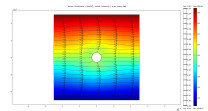
The paper presents and compares two models for simulating magneto-hydrodynamic flow of RedOx electrolyte in a conduit patterned with circular pillars. The first model solves the coupled Nernst-Planck and Navier-Stokes equations subjected to Butler-Volmer electrode kinetics and provides ... Mehr lesen
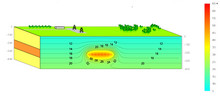
Disposal in deep clay geological formations is one of the promising options for disposal of high-level radioactive waste. Yet, they can generate considerable amounts of heat as a side effect of radioactive decay. This paper shows how COMSOL Multiphysics has been used to evaluate the ... Mehr lesen

As the flow passed through the pipe, and entered the bend, various vortical structures appear, meaning that there is a secondary flow emerging. Also while the flow is in the bend gravity forces affect distinctively its behavior as long as the centrifugal force is not greater. From this ... Mehr lesen


