Sehen Sie, wie die Multiphysik-Simulation weltweit in der Forschung eingesetzt wird
Multiphysik-Modellierung und -Simulation treiben Innovationen in Industrie und Wissenschaft voran – wie die zahlreichen Anwendungsbeispiele zeigen, die jedes Jahr in den Fachbeiträgen und Postern von Ingenieuren, Forschern und Wissenschaftlern auf der COMSOL Conference vorgestellt werden. Lassen Sie sich von den unten aufgeführten aktuellen Beiträgen inspirieren oder nutzen Sie die Schnellsuche, um eine bestimmte Präsentation zu finden oder nach Anwendungsbereich oder Konferenzjahr/-ort zu filtern.
Sehen Sie sich die Sammlung für die COMSOL Conference 2026 an
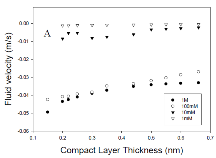
Electrofluidic transport through a single walled carbon nanotube (SWCNT) is enhanced by electroosmosis. Electroosmosis is made possible in these devices by the combination of a large slip length within SWCNTs and the interfacial potential at the solution/nanotube interface. A ... Mehr lesen
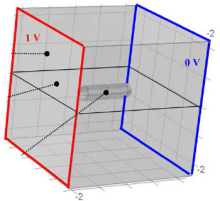
The subject of the interactions between electromagnetic (EM) fields and living cells is a strong issue for several decades [1]. Large number of works have been done to study the EM field penetration and inner induced currents in living microorganisms. Relevant information to be collected ... Mehr lesen
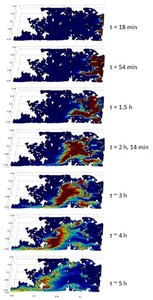
We apply COMSOL Multiphysics for reproducing our experimental observations of fluid flow and transport processes in geological media. Our experimental GeoEPT-method allows the 4D monitoring of transport processes in geological material on laboratory scale. Explicitly we import ... Mehr lesen
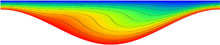
Heat transfer in a plane shear flow configuration consisting of two infinitely long parallel plates is considered. In laminar flows over undulated substrates eddies can be generated due to the kinematical constraints. A closed form analytical solution for the velocity field, based on ... Mehr lesen
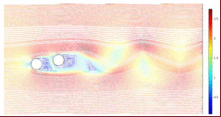
A 2-D unsteady viscous flow around two cylinders is studied by numerical solutions of the unsteady Navier-Stokes equations with a finite element formulation using COMSOL Multiphysics®. The results of a numerical investigation of the Strouhal frequencies of two identical, stationary, ... Mehr lesen

The 3D unit cell model approach offers an efficient tool to analyze the influences of geometrical design (channel shape and arrangement, filter length, wall thickness) and filter material properties (permeability, soot loading characteristics) on the performance of ceramic particle ... Mehr lesen

Microchannel heat sinks designed for applications in electronic cooling and having microscale heat transfer combine the attributes of high material compatibility, high surface area per unit volume ratios, and large potential heat transfer performance with a highly sophisticated and ... Mehr lesen

This work enunciates the principles of SAW design from a physical perspective, examining the standard engineering modelling assumptions in some detail. An integral form analytical expression based on 2D elastic isotropic theory is validated against a COMSOL Multiphysics® simulation, ... Mehr lesen