
Lorenzo Bortot, CERN, Switzerland
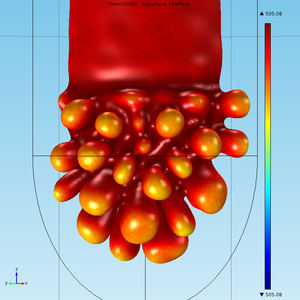
Engineers and physicists at CERN go to great lengths to ensure that the high-power superconducting magnets that maintain the circular trajectory of particles inside the Large Hadron Collider (LHC) do not revert to a resistive state, an event known as a quench. To understand and prevent quench events, Lorenzo Bortot, an electrical engineer and research fellow at CERN, used numerical simulation to develop a multiphysics, multiscale, and multirate representation of the electrodynamics and thermal evolution of a quench event.
Suggested Stories
Understanding the Origin of Uncertainty in Thermometer Calibration
Thermometers have widespread application and like any measurement device, they must be calibrated. Many do this with ...
Analyzing a Timeless Tradition Found in Ultra-Luxury Watches
Engineers at HEPIA, HES-SO Geneva are fine-tuning luxury-watch minute repeaters with a surrogate-model-led process ...
Look Inside the Battery with COMSOL Multiphysics®
The key to designing high-performance, durable, and safe batteries is to first understand the battery technology and ...
Keynote: Numerical Simulation of Primary Alkaline Zn–MnO2 Batteries
In this keynote talk from COMSOL Day: Batteries & Fuel Cells, Xiaotong Chadderdon of Energizer introduces primary ...


