
In Übereinstimmung mit unserer Qualitätspolitik unterhält COMSOL eine Bibliothek aus hunderten dokumentierter Modellbeispiele, die regelmäßig mit der neuesten Version der COMSOL Multiphysics® Software getestet werden, einschließlich Benchmark-Probleme von ASME und NAFEMS sowie TEAM-Probleme.
Unsere Verification and Validation (V&V) Testsuite bietet konsistent genaue Lösungen, die mit Analyseergebnissen und etablierten Benchmark-Daten verglichen werden. Die folgenden dokumentierten Modelle sind Teil der in der COMSOL Multiphysics® Software integrierten Anwendungsbibliotheken. Sie beinhalten Referenzwerte und Quellen für eine Vielzahl von Benchmarks sowie eine Schritt-für-Schritt-Anleitung, um die erwarteten Ergebnisse auf dem eigenen Computer zu reproduzieren. Mit diesen Modellen können Sie nicht nur Ihre Aufwendungen für die Software-Qualitätssicherung (SQA) und die numerische Code-Verifikation (NCV) dokumentieren, sondern sie auch im Rahmen von internen Trainingsprogrammen einsetzen.
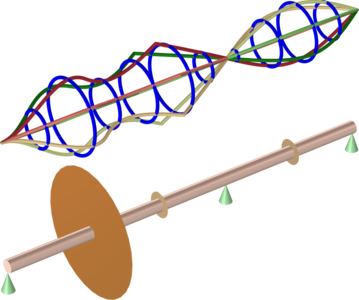
In this example, learn how to model two rotors connected by a spline coupling. The first rotor is a fixed cantilevered rotor and the second rotor is supported. The model assumes that only translational motion is coupled between the rotors through the coupling, while the rotations of both ... Mehr lesen
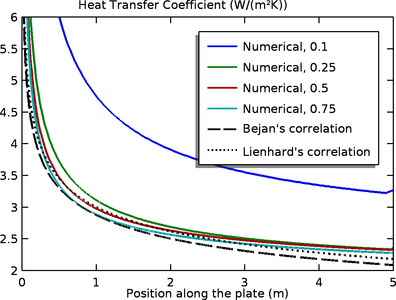
This verification model of nonisothermal turbulent flow over a flat plate compares the heat transfer coefficient obtained from simulation with theoretical values based on Nusselt number correlation functions that can be found in the literature. Mehr lesen
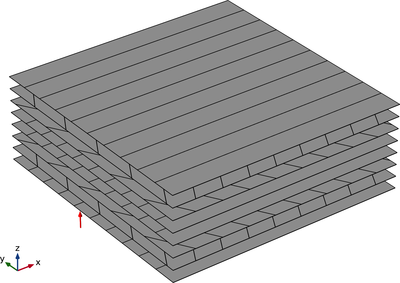
This model serves the purpose of validation and verification of the Linear Elastic Material, Layered model in the Shell interface. In COMSOL Multiphysics, composites are analyzed either based on Layerwise 3D elasticity theory through the Layered Shell interface or based on FSDT-ESL ... Mehr lesen
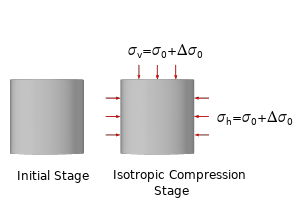
Isotropic compression is a common material test in soil mechanics. The modified Cam-Clay (MCC) model describes the relation between the void ratio and the logarithm of the pressure. In this example, a cylindrical soil sample under isotropic compression is simulated. It is verified that, ... Mehr lesen
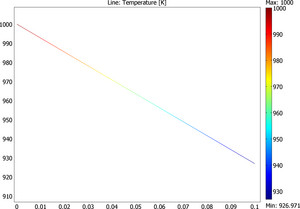
The example shows a 1D steady-state thermal analysis including radiation to a prescribed ambient temperature. The temperature field from the solution of this benchmark model is compared with a NAFEMS benchmark solution. Mehr lesen
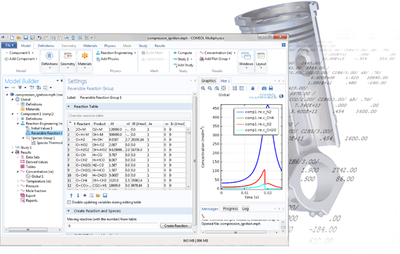
Homogeneous Charge Compression Ignition (HCCI) engines are being considered as an alternative to traditional spark- and compression-ignition engines. As the name implies, a homogeneous fuel/oxidant mixture is auto-ignited by compression with simultaneous combustion occurring throughout ... Mehr lesen

This example models the radiation of fan noise from the annular duct of a turbofan aeroengine. When the jet stream exits the duct, a vortex sheet appears along the extension of the duct wall due to the surrounding air moving at a lower speed. The near field on both sides of the vortex ... Mehr lesen
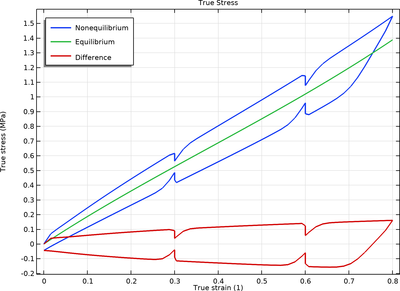
In this example, the Bergstrom–Boyce material model is used to capture the nonequilibrium behavior of carbon-black-filled chloroprene rubber under a strain history that alternates compression with relaxation. Results are verified against experimental and numerical results taken from the ... Mehr lesen
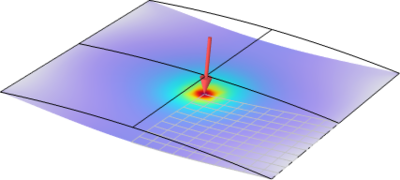
For slender structures, buckling can be a catastrophic instability if the service load exceeds the critical buckling load. For such structures, it can be important to study the structural behavior beyond the critical buckling load. Such a study is known as a postbuckling analysis. ... Mehr lesen

This example shows how to set up a model of furrow irrigation in a nonuniform soil column. It employs the Unsaturated Dual Permeability feature, which links two Richards' Equations through a fluid transfer function. This scenario can be regarded as a benchmark problem for dual ... Mehr lesen


