
In Übereinstimmung mit unserer Qualitätspolitik unterhält COMSOL eine Bibliothek aus hunderten dokumentierter Modellbeispiele, die regelmäßig mit der neuesten Version der COMSOL Multiphysics® Software getestet werden, einschließlich Benchmark-Probleme von ASME und NAFEMS sowie TEAM-Probleme.
Unsere Verification and Validation (V&V) Testsuite bietet konsistent genaue Lösungen, die mit Analyseergebnissen und etablierten Benchmark-Daten verglichen werden. Die folgenden dokumentierten Modelle sind Teil der in der COMSOL Multiphysics® Software integrierten Anwendungsbibliotheken. Sie beinhalten Referenzwerte und Quellen für eine Vielzahl von Benchmarks sowie eine Schritt-für-Schritt-Anleitung, um die erwarteten Ergebnisse auf dem eigenen Computer zu reproduzieren. Mit diesen Modellen können Sie nicht nur Ihre Aufwendungen für die Software-Qualitätssicherung (SQA) und die numerische Code-Verifikation (NCV) dokumentieren, sondern sie auch im Rahmen von internen Trainingsprogrammen einsetzen.

This example shows how to set up a model of furrow irrigation in a nonuniform soil column. It employs the Unsaturated Dual Permeability feature, which links two Richards' Equations through a fluid transfer function. This scenario can be regarded as a benchmark problem for dual ... Mehr lesen
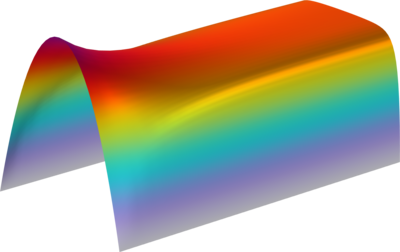
Classical MHD benchmark problem was solved analytically by J. Hartmann. He considered laminar incompressible flow between two planes (in planar duct) in transversal imposed magnetic field under next assumptions: * fully developed flow (far from inlet) * fluid properties are constant * ... Mehr lesen
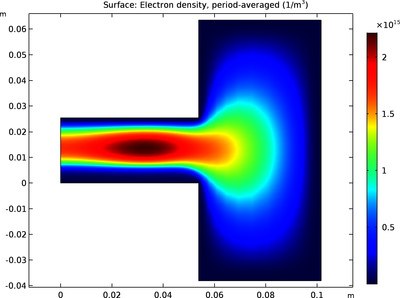
This model investigates the National Institute of Standards and Technology (NIST) Gaseous Electronics Conference (GEC) reference cell in two dimensions using the Plasma, Time Periodic interface. A 2D example helps in understanding the physics without excessive CPU time. The cell is ... Mehr lesen
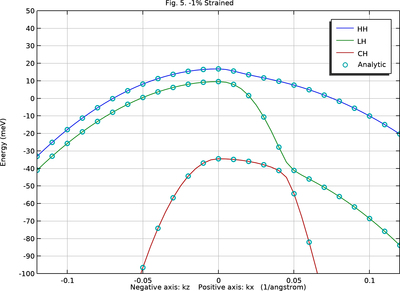
This benchmark model computes the valence band structure of an unstrained and a strained bulk GaN wurtzite crystal, as a tutorial for users who wish to set up multiple wave function components with the Schrödinger Equation interface. The model follows the formulation given in the ... Mehr lesen
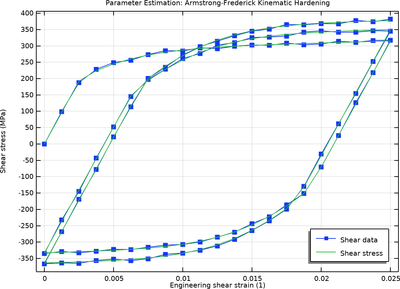
This tutorial model demonstrates how to estimate the material parameters of a combined hardening elastoplastic material model given cyclic shear data. Mehr lesen
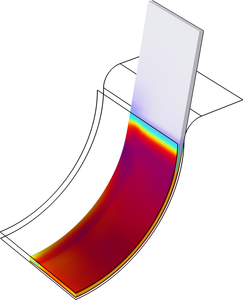
This example benchmarks a NAFEMS validation model of a friction contact problem with an elastoplastic material model. A thin metal sheet is forced into a die by a punch. Both the compressing displacement and the release of the punch are modeled in order to compute the forming angle (at ... Mehr lesen
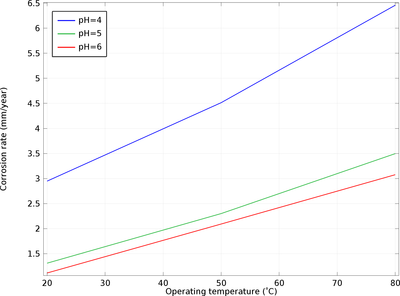
Carbon dioxide in aqueous solution is highly corrosive and can cause significant damage to steel designs. Such conditions arise in pipes used in a variety of applications, especially within the petrochemical industry. In this tutorial example, turbulent flows consisting of carbon ... Mehr lesen

Plasma discharges containing chlorine are commonly used to etch semiconductors and metals in microelectronics fabrication. This tutorial model studies chlorine plasma discharges using a global (volume-averaged) diffusion model. Global diffusion models can run simulations in a fraction ... Mehr lesen
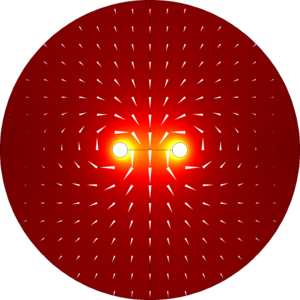
A parallel wire transmission line is composed of two conducting wires in a dielectric such as air. The fields around such a transmission line are not directly confined by the conductors, and extend to infinity, although they drop off in rapidly away from the wires. This model ... Mehr lesen

This benchmark studies the nonlinear deformation of a spherical cap subjected to point load at center using 2D axisymmetric Solid Mechanics and Shell interfaces. The results from the Shell interface are compared with Solid Mechanics interface as well as with analytical results given in ... Mehr lesen


