
In Übereinstimmung mit unserer Qualitätspolitik unterhält COMSOL eine Bibliothek aus hunderten dokumentierter Modellbeispiele, die regelmäßig mit der neuesten Version der COMSOL Multiphysics® Software getestet werden, einschließlich Benchmark-Probleme von ASME und NAFEMS sowie TEAM-Probleme.
Unsere Verification and Validation (V&V) Testsuite bietet konsistent genaue Lösungen, die mit Analyseergebnissen und etablierten Benchmark-Daten verglichen werden. Die folgenden dokumentierten Modelle sind Teil der in der COMSOL Multiphysics® Software integrierten Anwendungsbibliotheken. Sie beinhalten Referenzwerte und Quellen für eine Vielzahl von Benchmarks sowie eine Schritt-für-Schritt-Anleitung, um die erwarteten Ergebnisse auf dem eigenen Computer zu reproduzieren. Mit diesen Modellen können Sie nicht nur Ihre Aufwendungen für die Software-Qualitätssicherung (SQA) und die numerische Code-Verifikation (NCV) dokumentieren, sondern sie auch im Rahmen von internen Trainingsprogrammen einsetzen.
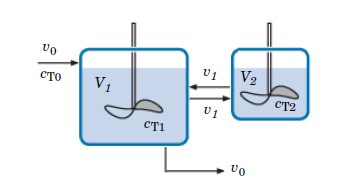
Real reactors can be modeled as combinations of ideal reactors. In this example the so-called "Dead zone model" is utilized. Two ideal CSTRs with interchange are set up to model the real reactor. One CSTR represents the highly agitated region and the other the less agitated region. For ... Mehr lesen
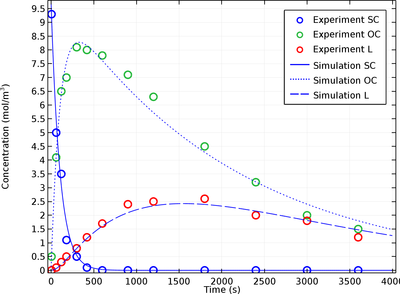
Biotechnology is a rapidly growing area in the pharmaceutical sciences. One example of a clinical application is gene therapy, where it is possible to produce proteins in vivo, using the body’s own mechanisms for protein production. Major issues in gene delivery involve the transport of ... Mehr lesen
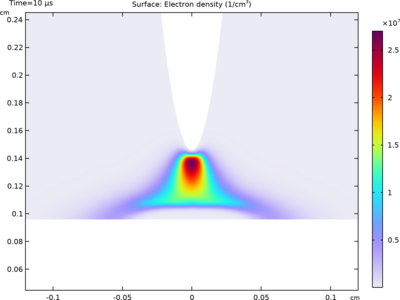
This model simulates a negative dielectric barrier discharge under a point-to-plate electrode configuration. Two solid dielectric layers are inserted into the air gap. A negative voltage of 2.5 kV is applied to the cathode electrode, initiating a corona streamer that propagates and ... Mehr lesen
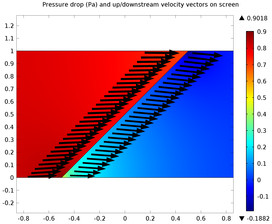
This model simulates the flow through a uniform inclined screen using the Screen feature in Single-Phase Flow physics and compares the results with an analytic solution. Mehr lesen

Unwanted arcing can have serious adverse effects on electrical and electronic equipment and systems. To improve the understanding and prediction of arc dynamics, it is crucial to conduct multiphysics simulations of transient arc processes. This model features a 3D simulation of transient ... Mehr lesen
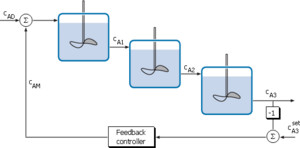
This example illustrates how to set up and solve a tank-in-series model in 0D using the Reaction Engineering interface. The model treats a series of three consecutive tank reactors. A feedback loop continuously adjusts the inlet concentration of the first tank to keep the concentration ... Mehr lesen
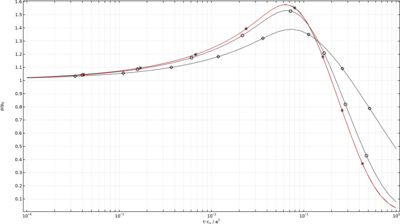
Cryer's problem is a three-dimensional consolidation benchmark. A porous sphere is subjected to a uniform boundary pressure. The pore pressure at the center of the sphere rises due to the Mandel-Cryer effect that is captured by a two-way coupling between Darcy's law and solid mechanics. Mehr lesen
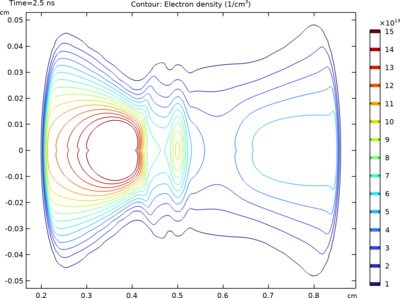
This model simulates the propagation of a double-headed streamer in nitrogen at atmospheric pressure. Initially, electron-positive ion clusters were introduced between two parallel electrodes, subjecting the gas to a strong background electric field of 52 kV/cm. Subsequently, both the ... Mehr lesen
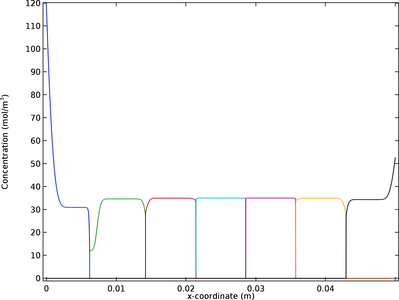
This model demonstrates isoelectric focusing (IEF) of seven ampholytes in a column. The model is in 1D and is solved in a time-dependent simulation. Mehr lesen
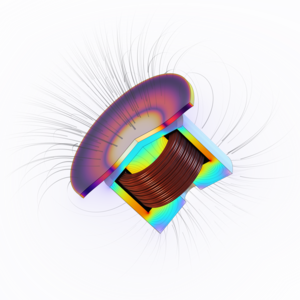
A magnetic diaphragm is a flexible, thin structure that interacts with magnetic fields to perform mechanical or sensing functions. When subjected to an external magnetic field, the diaphragm deforms due to magnetomechanical interactions, converting magnetic energy into mechanical ... Mehr lesen


