
Die Application Gallery bietet COMSOL Multiphysics® Tutorial- und Demo-App-Dateien, die für die Bereiche Elektromagnetik, Strukturmechanik, Akustik, Strömung, Wärmetransport und Chemie relevant sind. Sie können diese Beispiele als Ausgangspunkt für Ihre eigene Simulationsarbeit verwenden, indem Sie das Tutorial-Modell oder die Demo-App-Datei und die dazugehörigen Anleitungen herunterladen.
Suchen Sie über die Schnellsuche nach Tutorials und Apps, die für Ihr Fachgebiet relevant sind. Beachten Sie, dass viele der hier vorgestellten Beispiele auch über die Application Libraries zugänglich sind, die in die COMSOL Multiphysics® Software integriert und über das Menü File verfügbar sind.
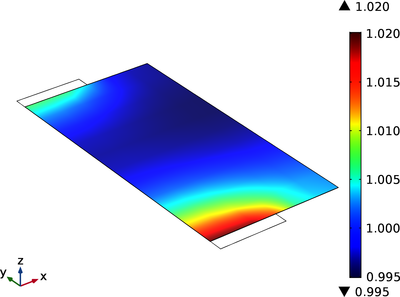
Große Lithium-Ionen-Akkus werden häufig in Elektrofahrzeugen und für stationäre Energiespeicheranwendungen eingesetzt. Beim Design der (gestapelten) Pouch-Akkuzellen verlässt der gesamte Strom die Zelle an den Zell-„Laschen“. Mit zunehmender Größe und Leistung der Zelle können die ... Mehr lesen

Liquid-liquid extraction is a process used to separate or transfer species between two immiscible liquids. Transfer of species from one phase to the other is driven by a difference in relative solubility. In this model a water filled extraction column is studied. Oil droplets containing ... Mehr lesen
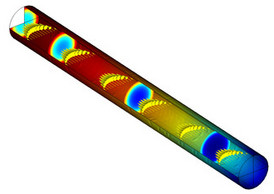
Tubular reactors are often used in continuous large-scale production, for example in the petroleum industry. One key design parameter is the conversion, or the amount of reactant that reacts to form the desired product. In order to achieve high conversion, process engineers optimize the ... Mehr lesen
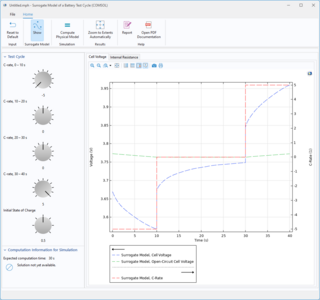
Diese App demonstriert die Verwendung eines Ersatzmodells zur Vorhersage der Zellspannung, der Leerlaufspannung und des Innenwiderstands einer NMC111/Graphit-Batteriezelle, die einem Batterietestzyklus unterzogen wird. Das Ersatzmodell, ein Deep Neural Network, wurde an einen Teil der ... Mehr lesen

This model describes the evaporation of a droplet that consists of concentrated solution of acetone and water. It accounts for the coupled phenomena of chemical species transport and heat transfer over phase boundaries (liquid-gas boundary) as well as for multiphase flow. The droplet ... Mehr lesen

In this example, three parallel pipelines of length 68 km and a horizontal separation distance of 10 m between them are protected against corrosion by an impressed current cathodic protection (ICCP) system using a series of anodes. Each anode is connected to all three pipelines, ... Mehr lesen
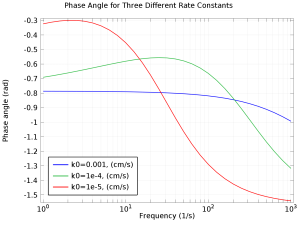
Der Zweck dieser App ist es, EIS-, Nyquist- und Bode-Plots zu verstehen. Mit der App können Sie die Volumenkonzentration, den Diffusionskoeffizienten, die Austauschstromdichte, die Doppelschichtkapazität sowie die maximale und minimale Frequenz variieren. Die elektrochemische ... Mehr lesen
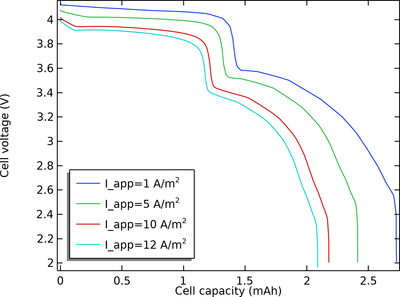
Sodium-ion batteries (SIB) are commonly presented as an alternative to lithium-ion batteries (LIB). The SIB chemistry uses Na+ instead of Li+ for electrolyte charge transport and as redox species in the electrode reactions, with the advantage of Na+ being more abundant and with a ... Mehr lesen


