
Die Application Gallery bietet COMSOL Multiphysics® Tutorial- und Demo-App-Dateien, die für die Bereiche Elektromagnetik, Strukturmechanik, Akustik, Strömung, Wärmetransport und Chemie relevant sind. Sie können diese Beispiele als Ausgangspunkt für Ihre eigene Simulationsarbeit verwenden, indem Sie das Tutorial-Modell oder die Demo-App-Datei und die dazugehörigen Anleitungen herunterladen.
Suchen Sie über die Schnellsuche nach Tutorials und Apps, die für Ihr Fachgebiet relevant sind. Beachten Sie, dass viele der hier vorgestellten Beispiele auch über die Application Libraries zugänglich sind, die in die COMSOL Multiphysics® Software integriert und über das Menü File verfügbar sind.

Active aerodynamics systems actuate components on a vehicle dynamically to improve fuel efficiency, optimize cooling, and enhance stability. A drag reduction system (DRS) is an example of an active aerodynamic technology, which is often used in Formula 1® cars to overtake other cars ... Mehr lesen
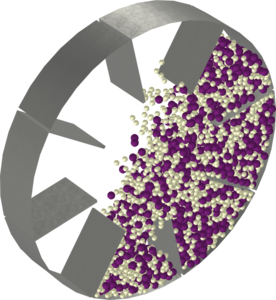
This model simulates the mixing of two types of grains in a rotating drum with baffles. The effect of the number of baffles on the mixing is demonstrated by varying the number of baffles in the drum. This model also demonstrates how to build and run a model method that evaluates the ... Mehr lesen
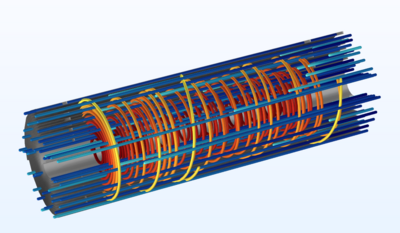
This example models a small reverse osmosis water desalination unit. The unit consists of a spirally wound semi-permeable membrane through which the water is forced under high pressure. The membrane retains the salt, such that on the permeate side fresh water is produced and on the ... Mehr lesen

This tutorial model can be used to learn how to calculate mass and energy balances. Get a detailed demonstration in this blog post: How to Calculate Mass Conservation and Energy Balance Mehr lesen
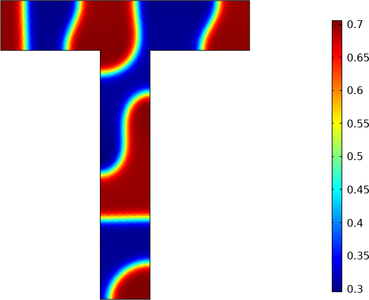
Many important processes in the mesoscale can be described by phase-field models. One of the oldest phase-field problems is the spinodal decomposition. Several standardized benchmark problems have been developed by the phase-field community. In this entry, these problems are solved using ... Mehr lesen
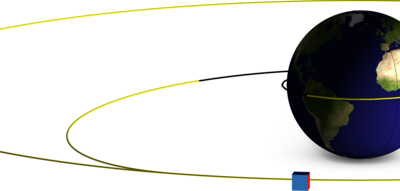
This model shows the workflow to define a transfer orbit trajectory with user defined orbit option. The direct solar, albedo, and Earth radiative thermal loads are analyzed during the transfer from low Earth orbit to geostationary orbit. Mehr lesen
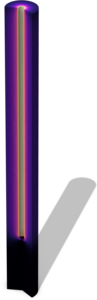
Fluence rate is a key parameter for ultraviolet (UV) water purifier. It describes the amount of radiation that pathogens absorb and is then directly related to the disinfection level of the purifier. The aim of this example is to demonstrate the fluence rate calculation with the ... Mehr lesen

The purpose of this model is to introduce the specular reflection in Surface-to-Surface Radiation using the ray-shooting algorithm. Different parameters are available to the user to yield better accuracy in the results when using the ray-shooting algorithm. The model is a standard ... Mehr lesen
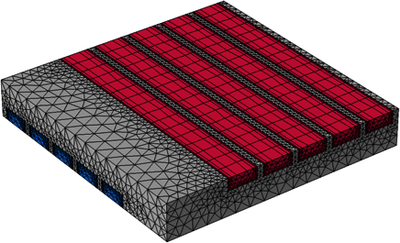
You can use assembly meshing to reduce the number of mesh elements in your model, which is especially useful for conjugate heat transfer simulation in cases where the fluid domains can be handled with swept mesh. These models demonstrate how to use form assembly and discontinuous meshes ... Mehr lesen
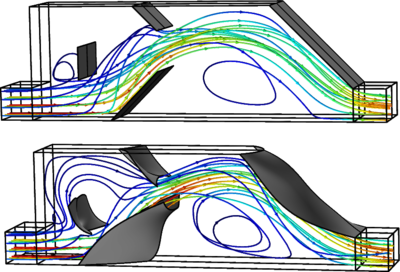
Tesla microvalves exploit the non-linear nature of inertial flow to create anisotropic flow resistance. They can be used as robust valves owing to their passive working mechanism, but for many applications the diodicity is too low. Two-dimensional simulations and optimization over ... Mehr lesen


