
Die Application Gallery bietet COMSOL Multiphysics® Tutorial- und Demo-App-Dateien, die für die Bereiche Elektromagnetik, Strukturmechanik, Akustik, Strömung, Wärmetransport und Chemie relevant sind. Sie können diese Beispiele als Ausgangspunkt für Ihre eigene Simulationsarbeit verwenden, indem Sie das Tutorial-Modell oder die Demo-App-Datei und die dazugehörigen Anleitungen herunterladen.
Suchen Sie über die Schnellsuche nach Tutorials und Apps, die für Ihr Fachgebiet relevant sind. Beachten Sie, dass viele der hier vorgestellten Beispiele auch über die Application Libraries zugänglich sind, die in die COMSOL Multiphysics® Software integriert und über das Menü File verfügbar sind.

This model is of the P.57 Type 4.3 Full-band Ear Simulator. The model includes the geometry of the ear canal as well as the pinna defined in the ITU-T P.57 standard. The model also includes interpolation data for an ear drum impedance ensuring correct acoustic properties of the ear. The ... Mehr lesen
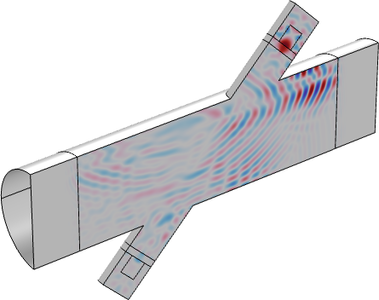
Ultraschall-Durchflussmesser bestimmen die Geschwindigkeit eines Fluids, das durch ein Rohr fließt, indem sie ein Ultraschallsignal in einem schrägen Winkel durch die Strömung senden. Wenn keine Strömung vorhanden ist, ist die Übertragungszeit zwischen dem Sender und dem Empfänger für ... Mehr lesen
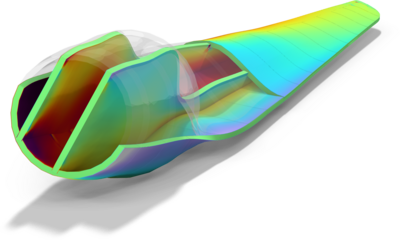
Windturbinen sind eine zunehmend beliebte Quelle für erneuerbare Energie. Daher sind das Design, die Analyse und die Herstellung von Windturbinen für die Energiewirtschaft von großer Bedeutung. Die Turbinenblätter sind entscheidende Komponenten einer Windturbine. Bei der Erzeugung von ... Mehr lesen

Die numerische Modellierung von Lamb-Wellen, die zu den geführten Wellen gehören, ist für die Analyse und das Design von Structural-Health-Monitoring-Systemen (SHM) für Ultraschallprüfungen mit großer Reichweite unerlässlich. Das Design eines SHM-Systems, das auf geführten Wellen ... Mehr lesen
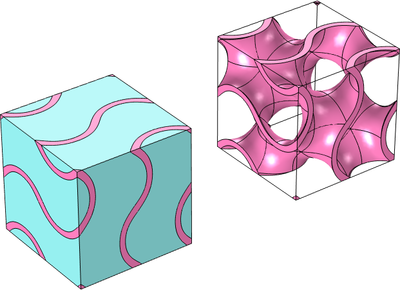
In this example, the homogenized elastic and thermal properties of a composite material based on a triply periodic minimal surface (TPMS) are computed. A gyroid TPMS-based unit cell is subjected to periodic boundary conditions to get the homogenized material properties. The effects of ... Mehr lesen
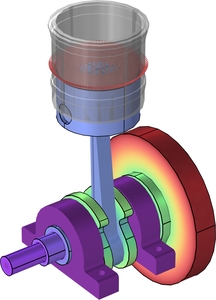
This example investigates a single cylinder reciprocating engine supported by hydrodynamic bearings. A starting torque brings the engine to the required speed, after which a load torque is applied. Following start-up, the engine operates under the action of the cylinder pressure. The ... Mehr lesen

This model showcases how to use fibers in thin layers to model thin anisotropic composites embedded in a solid without explicitly drawing either the layer of material or the reinforcing fibers. Here, it is used to model steel cords in tire belts that are used to provide structural ... Mehr lesen

This example shows how to compute deformations caused by secondary creep in a turbine stator blade. The creep rate is highly influenced by temperature, and the deformation and stress relaxation is thus controlled by the temperature field. Mehr lesen


