
Die Application Gallery bietet COMSOL Multiphysics® Tutorial- und Demo-App-Dateien, die für die Bereiche Elektromagnetik, Strukturmechanik, Akustik, Strömung, Wärmetransport und Chemie relevant sind. Sie können diese Beispiele als Ausgangspunkt für Ihre eigene Simulationsarbeit verwenden, indem Sie das Tutorial-Modell oder die Demo-App-Datei und die dazugehörigen Anleitungen herunterladen.
Suchen Sie über die Schnellsuche nach Tutorials und Apps, die für Ihr Fachgebiet relevant sind. Beachten Sie, dass viele der hier vorgestellten Beispiele auch über die Application Libraries zugänglich sind, die in die COMSOL Multiphysics® Software integriert und über das Menü File verfügbar sind.

This tutorial demonstrates how to use stationary polarization data to perform parameter estimation of a polymer electrolyte membrane fuel cell (PEMFC) model. The model, defining a 5-layer membrane electrode assembly (MEA) is two-dimensional and includes electronic and ionic charge ... Mehr lesen
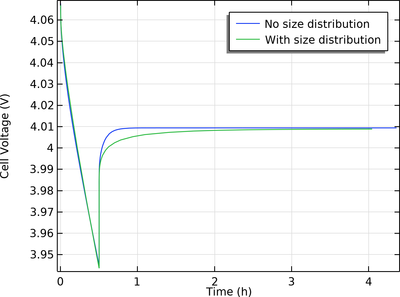
Battery electrodes featuring large heterogeneities in terms of particle sizes may sometimes not be adequately described by homogenized models using one single particle size only. As an alternative to adding multiple instances of the Additional Porous Electrode material node, this ... Mehr lesen
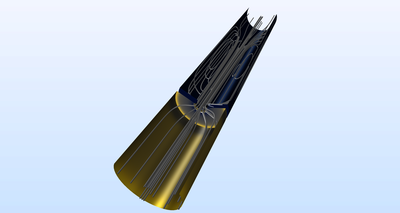
This example considers the turbulent flow of an oil-water suspension through an orifice. The oil droplets are broken up into smaller droplets by the turbulent stresses as the suspension passes through the orifice. The aim of this model is to track the distribution of droplet sizes. The ... Mehr lesen
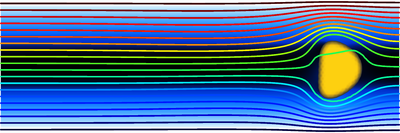
Applying an electric field across a suspension of immiscible liquids may stimulate droplets of the same phase to coalesce. The method known as electrocoalescence has important applications, for instance, in the separation of oil from water. To model electrocoalescence, you need to solve ... Mehr lesen
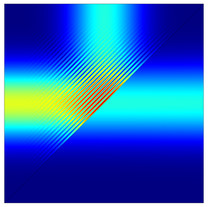
A beam splitter is used to split a single beam of light into two. One way of making a splitter is to deposit a thin layer of metal between two glass prisms. The beam is slightly attenuated within the layer, and split into two paths. In this example, the thin metal layer is modeled using ... Mehr lesen
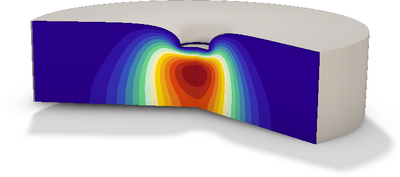
This example demonstrates how to use the Poroelasticity multiphysics coupling between the Solid Mechanics and Darcy's Law interfaces to model linear biphasic poroviscoelastic behavior of soft biological tissues. The implementation is verified using two numerical benchmarks from the ... Mehr lesen
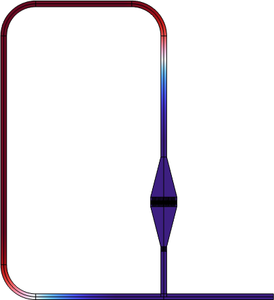
The models simulate the working mechanism of traveling wave thermoacoustic engines. Similary to the standing wave engines, the traveling wave engines make use of the coupling between the fluid motion and the temperature change experienced by the fluid to generate acoustic energy. ... Mehr lesen

This example is a model of a continuous casting process. Liquid metal is poured into a mold of uniform cross section. The outside of the mold is cooled and the metal solidifies as it flows through. When the metal leaves the mold, it is completely solidified on the outside, but still ... Mehr lesen
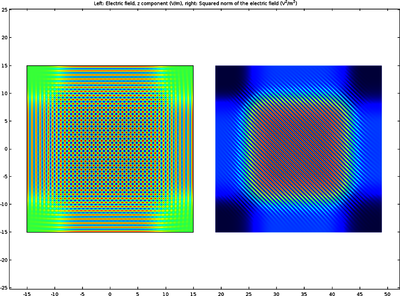
When two coherent light beams intersect, an interference pattern appears. If this occurs in a material that is sensitive to light, with intensities greater than a certain exposure threshold, the interference pattern is recorded in the material as a modulation of the refractive index and ... Mehr lesen
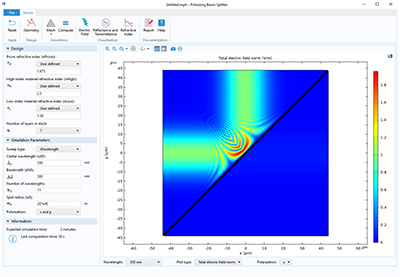
A Gaussian beam is incident on a 45-degree thin-film stack embedded in glass material prisms. The thin-film stack is designed from alternating high and low refractive index materials. The wave will be refracted at the Brewster angle at each internal interface. Thus, mainly p-polarized ... Mehr lesen


