
Die Application Gallery bietet COMSOL Multiphysics® Tutorial- und Demo-App-Dateien, die für die Bereiche Elektromagnetik, Strukturmechanik, Akustik, Strömung, Wärmetransport und Chemie relevant sind. Sie können diese Beispiele als Ausgangspunkt für Ihre eigene Simulationsarbeit verwenden, indem Sie das Tutorial-Modell oder die Demo-App-Datei und die dazugehörigen Anleitungen herunterladen.
Suchen Sie über die Schnellsuche nach Tutorials und Apps, die für Ihr Fachgebiet relevant sind. Beachten Sie, dass viele der hier vorgestellten Beispiele auch über die Application Libraries zugänglich sind, die in die COMSOL Multiphysics® Software integriert und über das Menü File verfügbar sind.
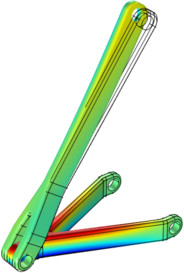
A hinge between two mechanical components is modeled by coupling two rigid connectors. This method can be used for simulating many types of mechanisms. In mechanical assemblies, parts are sometimes connected so that they are free to move relative to each other in one or more degrees of ... Mehr lesen
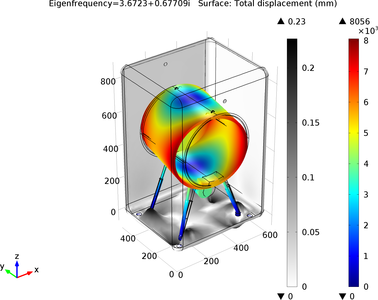
Vibration and noise caused by the nonuniform distribution of clothes in the drum are common problems in washing machines and are important considerations in their design and optimization. This model simulates a horizontal-axis portable washing machine using the Multibody Dynamics ... Mehr lesen
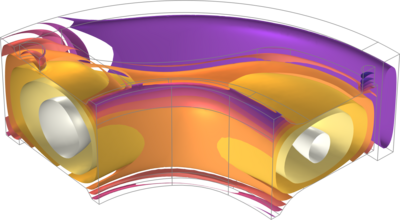
Modeling curing is important in a wide variety of applications such as for devices utilizing polymer materials, rubber materials, plastics, and concrete. Curing is usually an exothermic reaction. In the current example, curing of butyl rubber is studied in a 3D mold for an automotive ... Mehr lesen
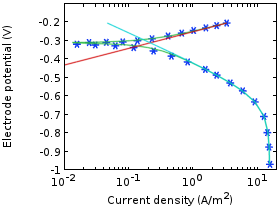
This tutorial shows how to use the Optimization interface to perform electrode kinetics parameter estimations based on polarization data. A zero-dimensional electrode polarization model is defined that separates kinetics expressions for the metal dissolution and the oxygen reduction ... Mehr lesen
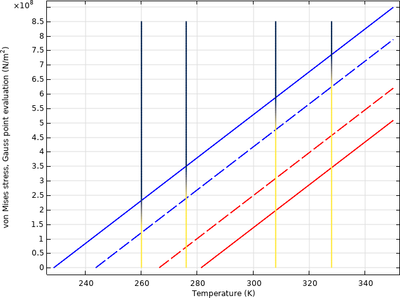
The model includes a compilation of benchmark examples included in the text book: Shape Memory Alloys: Modeling and Engineering Applications. D. Lagoudas Ed. Springer 2008. The model uses the Souza–Auricchio model and shows the thermomechanical properties of a NiTi alloy sample ... Mehr lesen

In this model of an ammonia-fed solid oxide fuel cell, the required hydrogen is supplied through endothermic thermal decomposition of ammonia. The model includes the full coupling between the mass balances and gas flow in the H2 and O2 gas diffusion electrodes, the momentum balances in ... Mehr lesen
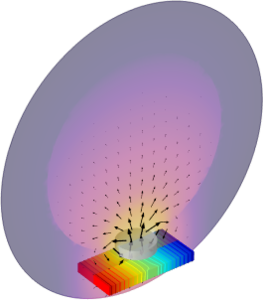
A Hall effect sensor is a semiconductive material with an anisotropic conductivity that is a function of the magnetic field. A magnet, mounted on a wheel, is rotated around nearby the sensor and the variation in the electric potential across the sensor is modeled. For complete ... Mehr lesen
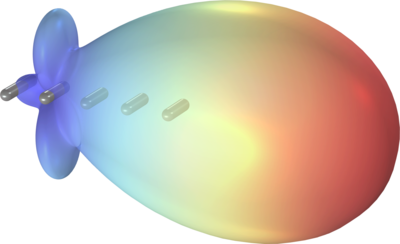
This model demonstrates the use of boundary element method in the Electromagnetic Waves, Boundary Element interface to model an optical Yagi-Uda antenna. The antenna is driven by an electrical point dipole, which is implemented through the background field. The field distribution around ... Mehr lesen
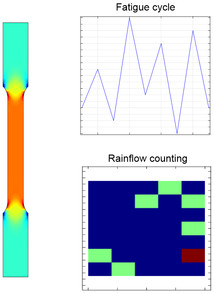
Ein Benchmark-Modell des Rainflow-Zählalgorithmus vergleicht die Ergebnisse zwischen dem ASTM- und dem COMSOL-Ermüdungsmodul unter Verwendung eines flachen Zugprüfkörpers. Es wird eine Erweiterung für die Berechnung der kumulativen Schädigung nach dem Palmgren-Miner-Modell vorgenommen ... Mehr lesen
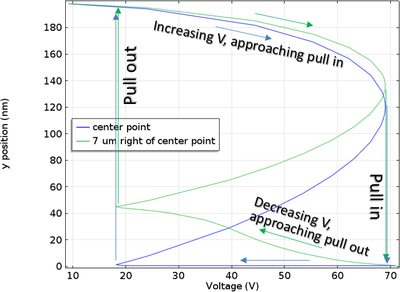
An electrostatically actuated MEMS resonator is simulated. The device is driven by an AC + DC bias voltage applied across a parallel plate capacitor. In this example, the pull-in and pull-out voltages of the resonator are computed. This is done via a quasi-static analysis of the ... Mehr lesen


