
Die Application Gallery bietet COMSOL Multiphysics® Tutorial- und Demo-App-Dateien, die für die Bereiche Elektromagnetik, Strukturmechanik, Akustik, Strömung, Wärmetransport und Chemie relevant sind. Sie können diese Beispiele als Ausgangspunkt für Ihre eigene Simulationsarbeit verwenden, indem Sie das Tutorial-Modell oder die Demo-App-Datei und die dazugehörigen Anleitungen herunterladen.
Suchen Sie über die Schnellsuche nach Tutorials und Apps, die für Ihr Fachgebiet relevant sind. Beachten Sie, dass viele der hier vorgestellten Beispiele auch über die Application Libraries zugänglich sind, die in die COMSOL Multiphysics® Software integriert und über das Menü File verfügbar sind.
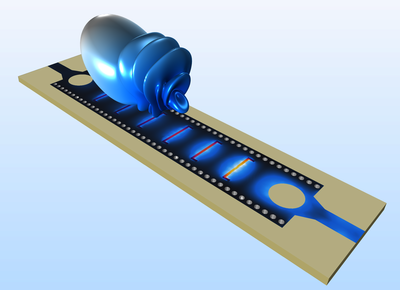
Substrate Integrated Waveguides (SIW) can be used in antenna applications. Leaky waves from a slot array on the top surface of the SIW in this model generate a beam in a certain direction that can be steered by choosing a different operating frequency. Mehr lesen
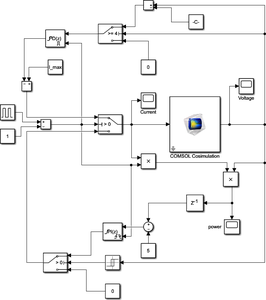
This model illustrates the charge/discharge control of a Lithium-Ion battery in a Simulink® simulation. Mehr lesen
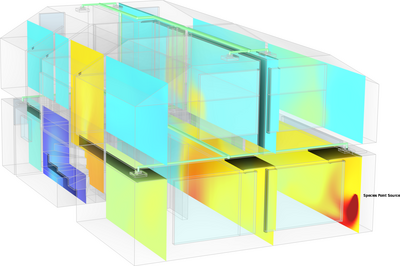
This model of a two-story house can be used to examine a contaminant leak and the subsequent contaminant dispersion that occurs due to convection and diffusion. Airflow and recirculation within the home are dependent on vent placement, and flow velocity may also vary at each vent. ... Mehr lesen
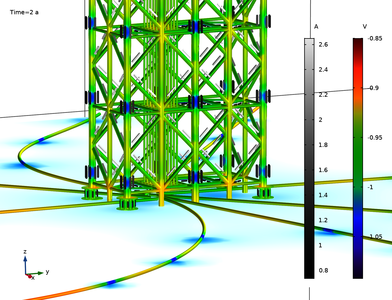
This full-scale, time-dependent model of an offshore oil platform jacket involves modeling coating breakdown and estimating sacrificial anode life and the buildup of calcareous deposits on steel surfaces. The tutorial model aims to answer some of the common questions surrounding ... Mehr lesen

Tutorial model that demonstrates how to work with COMSOL models in Excel, including loading and saving files, updating model parameters, solving, and retrieving results. Mehr lesen
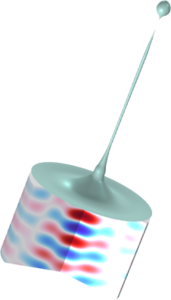
Acoustic droplet ejection is a non-contact, highly controllable method for liquid handling emerging in applications such as printing, biomedical, semiconductor assembly, and mass spectroscopy. The modeling approach assumes separation of acoustic and flow time scales. First, a focused ... Mehr lesen
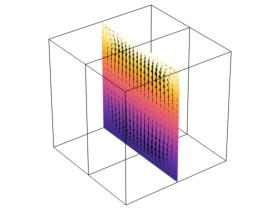
This example studies the stationary state of free convection in a cavity filled with water and bounded by two vertical plates. To generate the buoyancy flow, the plates are heated at different temperatures, bringing the regime close to the transition between laminar and turbulent. To ... Mehr lesen

This example shows how to make a simple model for a binary distillation process. A thermodynamics property package, available in the Chemical Reaction Engineering Module, is created to study the separation of a nonideal mixture of ethanol and water. The required equilibrium relationship ... Mehr lesen


