
Die Application Gallery bietet COMSOL Multiphysics® Tutorial- und Demo-App-Dateien, die für die Bereiche Elektromagnetik, Strukturmechanik, Akustik, Strömung, Wärmetransport und Chemie relevant sind. Sie können diese Beispiele als Ausgangspunkt für Ihre eigene Simulationsarbeit verwenden, indem Sie das Tutorial-Modell oder die Demo-App-Datei und die dazugehörigen Anleitungen herunterladen.
Suchen Sie über die Schnellsuche nach Tutorials und Apps, die für Ihr Fachgebiet relevant sind. Beachten Sie, dass viele der hier vorgestellten Beispiele auch über die Application Libraries zugänglich sind, die in die COMSOL Multiphysics® Software integriert und über das Menü File verfügbar sind.

A diplexer is a device that combines or splits signals into two different frequency bands, widely used in mobile communication systems. This model simulates splitting properties using a simplified 2D geometry. The computed S-parameters and electric fields at the lower and upper bands ... Mehr lesen
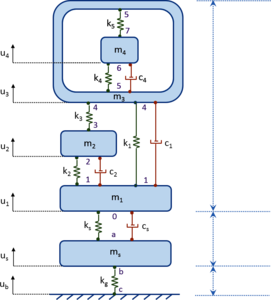
Several mass–spring–damper models have been developed to study the response of a human body where mass, spring, and damper elements represent mass of different body parts, stiffness, and damping properties of various tissues. In this example, a lumped model of a human body having five ... Mehr lesen
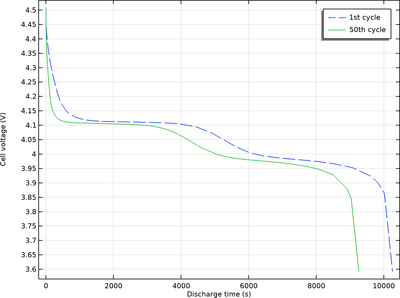
Some positive electrode materials are known to deteriorate in overcharged lithium-ion battery cells. Predominantly, manganese containing electrode materials such as LMO and NMC can loose capacity due to manganese dissolving from the materials at overcharge. This decomposition is a ... Mehr lesen

This example shows how to perform a High Cycle Fatigue (HCF) analysis with a non-proportional load history caused by a transversal force and a torque which are applied in different combinations. Three different fatigue models (Findley, Matake, and Dang Van) are compared. Mehr lesen
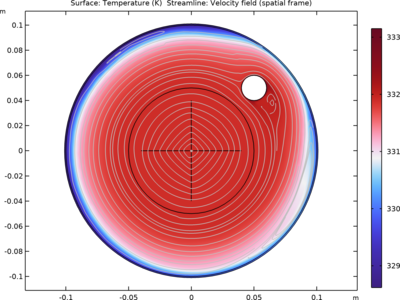
This model illustrates the modeling of temperature distribution in a simplified mixer. Mehr lesen
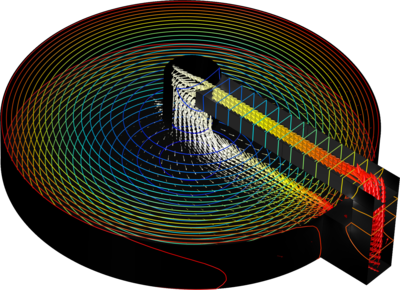
A homopolar generator is composed of an electrically conductive rotating disc placed in a uniform magnetic field that is perpendicular to the plane of rotation. The motion of the conductor through the static magnetic field induces Lorentz currents in the disc. By connecting the outside ... Mehr lesen
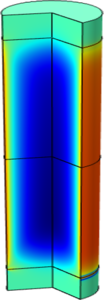
A gate-all-around MOSFET consists of a nanowire with a gate electrode wrapped around the circumference. Since the entire nanowire forms the channel, this configuration provides the best possible electrostatic control of the channel and offers a good candidate for the miniaturization of ... Mehr lesen
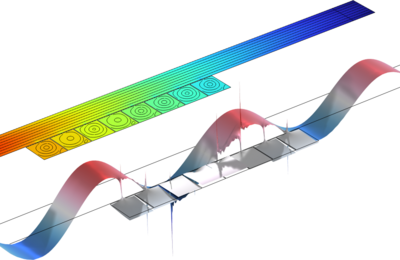
This model demonstrates how to compute the acoustic properties of an acoustic liner with a grazing flow. The liner consists of eight resonators with thin slits. The background grazing flow is at Mach number 0.3. The sound pressure level above the liner is computed and can be compared to ... Mehr lesen


