
Die Application Gallery bietet COMSOL Multiphysics® Tutorial- und Demo-App-Dateien, die für die Bereiche Elektromagnetik, Strukturmechanik, Akustik, Strömung, Wärmetransport und Chemie relevant sind. Sie können diese Beispiele als Ausgangspunkt für Ihre eigene Simulationsarbeit verwenden, indem Sie das Tutorial-Modell oder die Demo-App-Datei und die dazugehörigen Anleitungen herunterladen.
Suchen Sie über die Schnellsuche nach Tutorials und Apps, die für Ihr Fachgebiet relevant sind. Beachten Sie, dass viele der hier vorgestellten Beispiele auch über die Application Libraries zugänglich sind, die in die COMSOL Multiphysics® Software integriert und über das Menü File verfügbar sind.
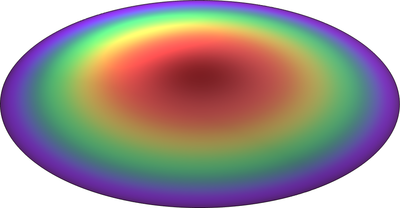
This tutorial shows how to evaluate the harmonic response of a structure with a moderately nonlinear behavior. A nonlinear problem can only be solved using time-domain analysis. A way to speed up the computation is to use a linearized frequency response analysis to provide good initial ... Mehr lesen
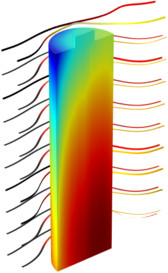
Dieses Beispiel simuliert das Wärmeprofil in einem luftgekühlten zylindrischen Akku in 3D. Der Akku befindet sich in einer Matrix in einem Akkupack. Das thermische Modell ist mit einem 1D- Akkumodell gekoppelt, das verwendet wird, um eine Wärmequelle im aktiven Akkumaterial zu erzeugen. Mehr lesen

In an alkaline electrolyzer stack, all cells share the same electrolyte. As a result of all cells being in ionic contact, parasitic shunt currents flow between the cells through the manifolds and the electrolyte channels, on both the inlet and outlet side. This example models a ... Mehr lesen
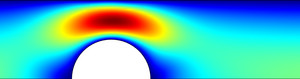
Many complex fluids of interest exhibit a combination of viscous and elastic behavior under strain. Examples of such fluids are polymer solutions and melts, oil, toothpaste, and clay, among many others. The Oldroyd-B fluid presents one of the simplest constitutive models capable of ... Mehr lesen
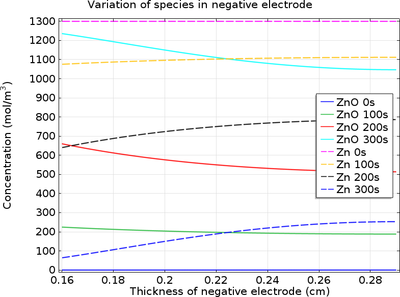
Zinc-Silver oxide (Zn-AgO) batteries are used in different industries due to their high capacity per unit weight. In this work, discharge of a Zn-AgO battery is simulated using the Battery with Binary Electrolyte interface. The electrochemical reactions in the positive and negative ... Mehr lesen

This app demonstrates the following: Multiple tabs in the ribbon Geometry parts and parameterized geometries Parts and cumulative selections can be used to automatically set domain and boundary settings in the embedded model Adding or removing geometry parts with different geometrical ... Mehr lesen

This app demonstrates the following: Importing measured data from a text file Handling measured data using methods Exporting the results to a text file Exporting the results as COMSOL Material Library file. The app is a companion to the Effective Nonlinear Constitutive Relations ... Mehr lesen

A plane electromagnetic wave is incident on a metallic sphere partially embedded on a substrate. In this electromagnetic scattering problem, the far-field variables are computed for a few elevation angles of incidence. Mehr lesen

Bei der Modellierung des Transports durch Diffusion oder Leitung in dünnen Schichten stößt man häufig auf große Unterschiede in den Abmessungen der verschiedenen Gebiete in einem Modell. Handelt es sich bei der modellierten Struktur um eine so genannte Sandwichstruktur, können wir die ... Mehr lesen
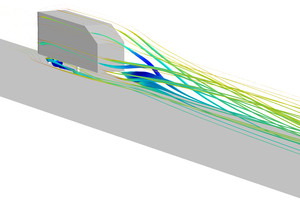
Der Ahmed-Körper stellt eine vereinfachte, bodennahe Fahrzeuggeometrie eines stumpfen Körpers (bluff body) dar. Seine Form ist einfach genug, um eine genaue Strömungssimulation zu ermöglichen, behält aber einige wichtige praktische Merkmale bei, die für Automobilkarosserien relevant ... Mehr lesen


