
Die Application Gallery bietet COMSOL Multiphysics® Tutorial- und Demo-App-Dateien, die für die Bereiche Elektromagnetik, Strukturmechanik, Akustik, Strömung, Wärmetransport und Chemie relevant sind. Sie können diese Beispiele als Ausgangspunkt für Ihre eigene Simulationsarbeit verwenden, indem Sie das Tutorial-Modell oder die Demo-App-Datei und die dazugehörigen Anleitungen herunterladen.
Suchen Sie über die Schnellsuche nach Tutorials und Apps, die für Ihr Fachgebiet relevant sind. Beachten Sie, dass viele der hier vorgestellten Beispiele auch über die Application Libraries zugänglich sind, die in die COMSOL Multiphysics® Software integriert und über das Menü File verfügbar sind.
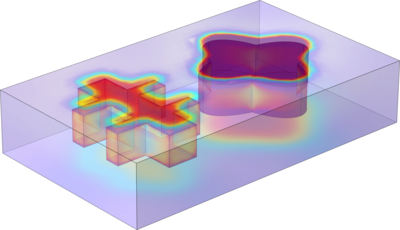
This example shows how to image the interior permittivity of a box by applying a potential difference on the boundaries of the box. The result is a surface charge density that depends on the permittivity of the medium inside the box. Read about this tutorial model in our blog post "The ... Mehr lesen
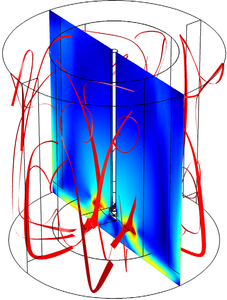
This tutorial example simulates the flow in a flat bottom mixer containing, agitated by a pitched four blade impeller, where the fluid is water, and flow is assumed to be turbulent. The flow in the mixer is modeled using the k-ε turbulence model, and a time-dependent simulation ... Mehr lesen
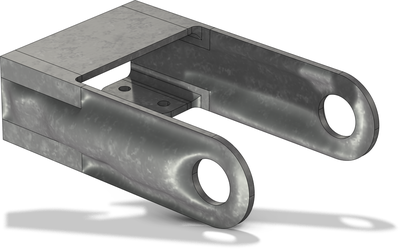
In his example, the lowest natural frequency of a 3D bracket are maximized using shape optimization. Mehr lesen
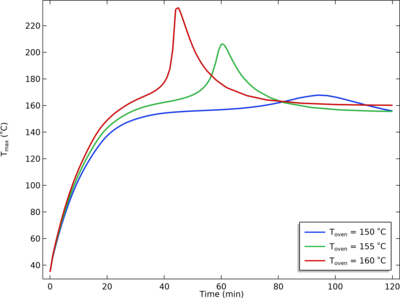
Dieses Beispiel simuliert die Temperaturdynamik in einer zylindrischen Batterie, die zunächst Raumtemperatur hat, nachdem sie in einen Ofen gestellt wurde. Mit steigender Temperatur werden verschiedene exotherme Zersetzungsreaktionen aktiviert, die wiederum zu einer weiteren Erwärmung ... Mehr lesen

Predicting the transport of solutes that move with subsurface fluids is of general interest in environmental engineering and geosciences. Solutes may not only be pollutants but also artifical tracers added to the groundwater for investigation purposes. This model tracks a solute over ... Mehr lesen

A benchmark model where a thick plate exposed to pressure on the top surface is analyzed. The solution is compared with a NAFEMS benchmark solution. Mehr lesen
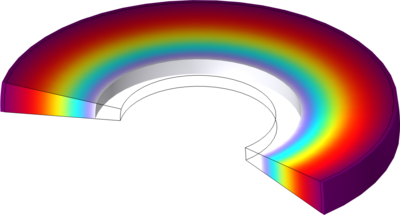
Creep is an inelastic time-dependent deformation which occurs when a material is subjected to stress at sufficiently high temperature, say 40% of the melting point or more. Experimental creep data (using constant stress and temperature) often display three different types of behavior ... Mehr lesen

Striking a drum excites a spectrum of vibration modes that together make up the instrument’s characteristic sound or acoustic signal. These vibration modes correspond to the eigenmodes, or eigenfunctions, of the drum’s membrane. Thus you can study this problem by solving eigenvalue ... Mehr lesen
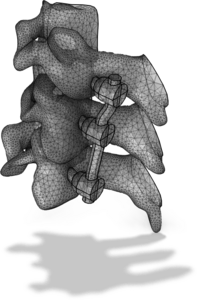
In dieser Tutorial-Serie erfahren Sie, wie Sie mit importierten Oberflächennetzen arbeiten können. Die Anleitung beschreibt, wie Sie STL-Dateien von zwei Wirbeln und einer Bandscheibe importieren und wie Sie Löcher, falsch ausgerichtete Netzpunkte und sich überschneidende Elemente ... Mehr lesen

In complex mechanical systems, it can be challenging to find an optimal (or even good enough) solution only through engineering insight or trial-and-error procedures. Using mathematical optimization methods can then be an efficient path to a better design. In this example, a link ... Mehr lesen


