
Die Application Gallery bietet COMSOL Multiphysics® Tutorial- und Demo-App-Dateien, die für die Bereiche Elektromagnetik, Strukturmechanik, Akustik, Strömung, Wärmetransport und Chemie relevant sind. Sie können diese Beispiele als Ausgangspunkt für Ihre eigene Simulationsarbeit verwenden, indem Sie das Tutorial-Modell oder die Demo-App-Datei und die dazugehörigen Anleitungen herunterladen.
Suchen Sie über die Schnellsuche nach Tutorials und Apps, die für Ihr Fachgebiet relevant sind. Beachten Sie, dass viele der hier vorgestellten Beispiele auch über die Application Libraries zugänglich sind, die in die COMSOL Multiphysics® Software integriert und über das Menü File verfügbar sind.

Ultrahigh Molecular Weight (UHMW) Polyethylene is a material commonly employed in knee and hip joint replacements. The “small punch test” is designed to assess mechanical properties using very small samples, such that because of their size they can directly be explanted. This example ... Mehr lesen
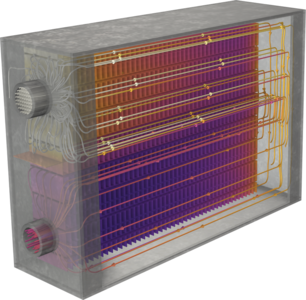
This tutorial model shows how a plate-fin heat exchanger made of aluminum is used to cool down hot oil with colder air. In order to maximize heat transfer, the heat exchanger is made of a porous aluminum matrix in which the hot oil flows. Heat is conducted through aluminum fins in ... Mehr lesen
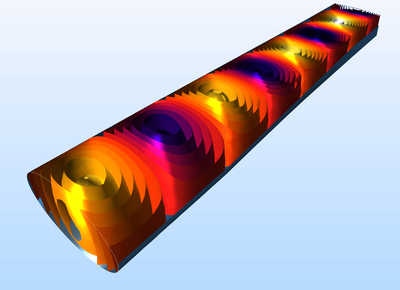
Dies ist ein Modell eines Adapters für die Mikrowellenausbreitung im Übergang zwischen einem rechteckigen und einem elliptischen Wellenleiter. Solche Wellenleiteradapter sind so konzipiert, dass die Energieverluste aufgrund von Reflexionen bei den Betriebsfrequenzen minimal sind. Um die ... Mehr lesen
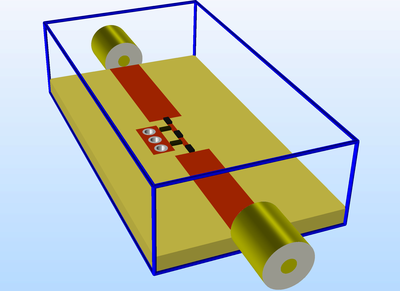
A Touchstone file describes the frequency responses of an n-port network circuit in terms of S-parameters. This can be used to simplify arbitrarily complex circuits. The Touchstone file can be obtained from numerical simulations or network analyzer measurements. The obtained file for a ... Mehr lesen
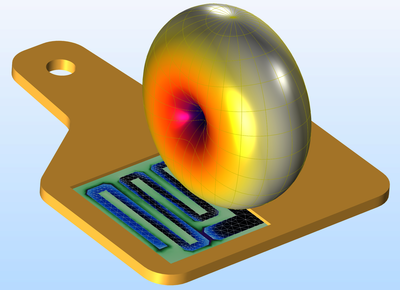
UHF RFID tags are widely used for identifying and tracking animals. This model simulates a passive radio-frequency identification (RFID) tag for the UHF frequency range. With respect to the chip transponder’s complex impedance, a reflection coefficient is computed. This is done using an ... Mehr lesen
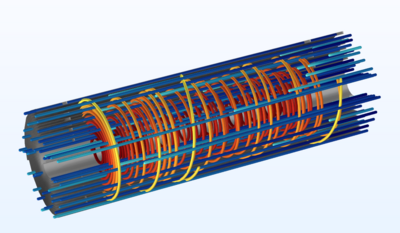
This example models a small reverse osmosis water desalination unit. The unit consists of a spirally wound semi-permeable membrane through which the water is forced under high pressure. The membrane retains the salt, such that on the permeate side fresh water is produced and on the ... Mehr lesen
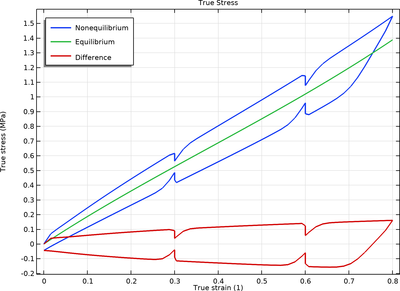
In this example, the Bergstrom–Boyce material model is used to capture the nonequilibrium behavior of carbon-black-filled chloroprene rubber under a strain history that alternates compression with relaxation. Results are verified against experimental and numerical results taken from ... Mehr lesen
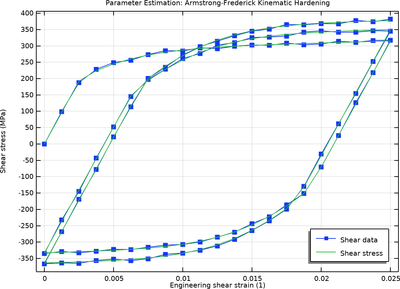
This tutorial model demonstrates how to estimate the material parameters of a combined hardening elastoplastic material model given cyclic shear data. Mehr lesen
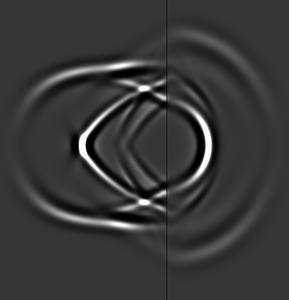
In this 2D tutorial, a test sample consists on one side of an isotropic material and on the other side of a heterogeneous anisotropic material (a transverse anisotropic zinc crystal). Elastic waves in the sample are excited by a point-like force. The model is solved with the Elastic ... Mehr lesen

This app demonstrates the following: A model using symmetry while the results are visualized in full 3D Provides info if the results are above or below certain critical values Selecting predefined or user-defined materials Error control of geometry parameters using methods and ... Mehr lesen


