Using Discontinuous Meshes for Conjugate Heat Transfer Modeling
Walter Frei November 21, 2018
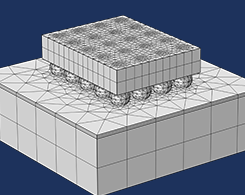
Did you know that the COMSOL Multiphysics® software allows you to have different discontinuous meshes in neighboring domains? Although the usual default behavior of the software is to use aligned meshes, there are times when we might like to have discontinuous meshes, such as for modeling conjugate heat transfer. Let’s delve deeper into this topic and see how these meshes can save us time and memory in our initial model development with just a little bit more effort.
Weiterlesen
Christian Wollblad June 13, 2018
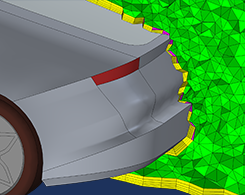
We have already discussed the factors that make a high-quality mesh and how to prepare a CFD model geometry for meshing. In this follow-up blog post, learn about physics-controlled meshing, adaptive mesh refinement, and how to use a variety of meshing tools in the COMSOL Multiphysics® software for your fluid flow simulations.
Weiterlesen
Christian Wollblad June 11, 2018
The quality of a computational fluid dynamics (CFD) model is often determined by the quality of the mesh used to solve the problem. A good mesh facilitates convergence, reduces memory requirements, and results in accurate solutions. It is therefore worthwhile to invest time and thought into creating the mesh when solving a CFD problem. In this blog post, we describe the factors of a quality mesh and how to prepare a fluid flow model geometry for meshing.
Weiterlesen
Edmund Dickinson January 17, 2018
As two of the greatest mathematicians to have ever lived, Leonhard Euler and Joseph-Louis Lagrange made numerous contributions to continuum mechanics. Combining their individual descriptions of the subject inspired the arbitrary Lagrangian-Eulerian (ALE) method, a technique that can be used for a multitude of simulation applications. Find out how the work of Euler and Lagrange helped create the ALE method and how it aids your simulations in the COMSOL Multiphysics® software.
Weiterlesen
Hanna Gothäll May 12, 2017
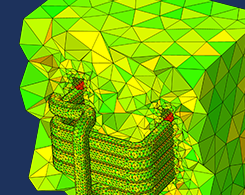
Creating a suitable mesh for your FEA simulations is crucial for getting accurate results. In this blog post, we discuss how to check entities reported in mesh warnings and errors, how to view the statistics of a mesh or parts of a mesh, as well as how to plot the mesh and mesh-specific quantities and delimit these plots to selected regions.
Weiterlesen
Björn Bretz September 27, 2016
To help optimize your modeling processes, we are continuously striving to enhance the quality of our meshing capabilities. The recent improvements to the algorithm for generating tetrahedral meshes in the COMSOL Multiphysics® software are one such example. Follow along as we guide you through the process of generating a tetrahedral mesh to highlight this improved functionality and its correlating features, while discussing its role in helping you obtain better simulation results.
Weiterlesen
Hanna Gothäll September 14, 2016
STL files originating from 3D scan sources and meshes in the NASTRAN® file format are often used as bases for geometries. However, performing simulations on these realistic objects can be challenging, particularly when preparing the geometry. The COMSOL Multiphysics® software contains features for dealing with these files. Learn how to utilize this functionality as well as how to achieve good results when importing STL and NASTRAN® files.
Weiterlesen
Caty Fairclough August 18, 2016
Does your simulation take a large amount of computational time to solve? One potential reason for this is that your mesh is using too many elements. In cases such as this, you may want to switch to user-controlled mesh to manually build and edit the meshing sequences available in the COMSOL Multiphysics® software as an alternative to using the default meshing sequence. As we’ll highlight with a tutorial example, this can help reduce memory requirements while providing accurate results.
Weiterlesen
Walter Frei April 6, 2016
Have you ever wanted to write out mesh and analysis data from COMSOL Multiphysics into a text file? You may want to do this when passing information to another software program or even just into a spreadsheet. You often want to customize the exact format in which such data is written, depending upon the needs of the other tools with which you are working. This is very easy to do with the Application Builder. Let’s find out how!
Weiterlesen
Walter Frei December 29, 2015
While designing a structure, have you ever been unsure of how to achieve the best shape? If so, then you will want to add a useful technique called shape optimization to your COMSOL Multiphysics modeling skill set. Today, we will discuss the concept of shape optimization and demonstrate its use through a classical problem.
Weiterlesen
Walter Frei December 24, 2015
In this blog post, we will introduce the concept of shape optimization for adjusting part dimensions by using analytic sensitivity methods. If you have a single objective function that you want to improve, a set of geometric parameters that you want to change, as well as a set of constraints, then you can use the functionality of the Optimization Module and the Deformed Geometry interface in COMSOL Multiphysics to find the optimal structure without any remeshing. Let’s find out how!
Weiterlesen